04 February 2026
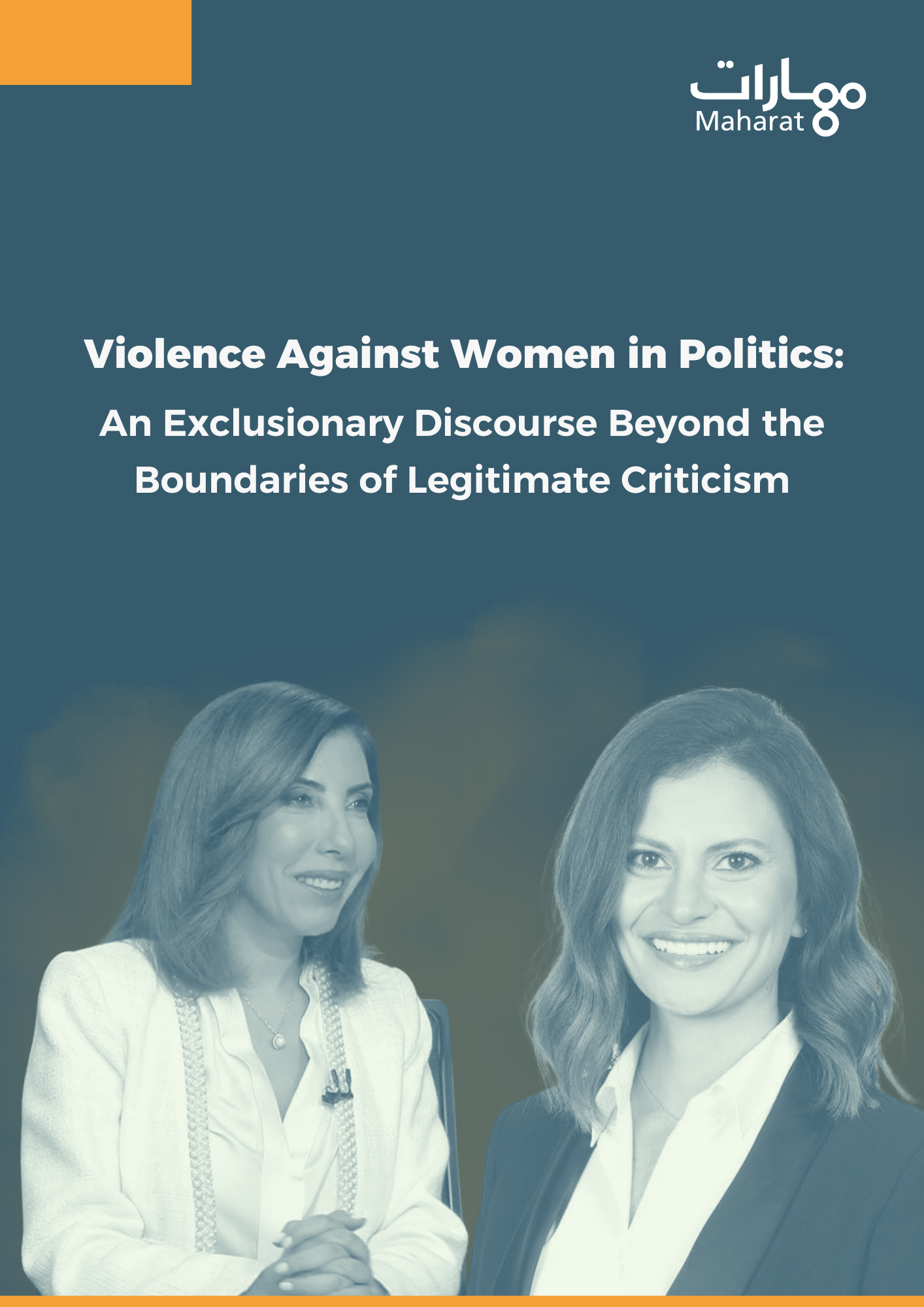
Violence Against Women in Politics: An Exclusionary Discourse Beyond the Boundaries of Legitimate Criticism
🧠 Why does this matter?
Despite the growing participation of women in Lebanese political life, violence against women in politics (VAWP) continues to surface in political and media discourse. Criticism of positions often shifts toward personal mockery, stereotyping, and insult, with the aim of undermining women’s political legitimacy and excluding them from public debate. Monitoring and naming these practices is essential to protecting the right to equal political participation and to preventing the normalization of discourses that reproduces discrimination and turns insults into an accepted practice in public life. The recent cases targeting MPs Halima Kaakour and Nada Boustani clearly reflect this pattern.
📍 What is the form of violence?
🔎 Case 1: Dismissive discourse and personal attacks instead of substantive debate on MP Halima Kaakour’s political position
During an episode of the program “Sar El Waet” aired on 29 January 2026, the leader of the Lebanese Forces Party, Samir Geagea, commented on a position taken by MP Halima Kaakour during a parliamentary session by saying:
“We can’t keep up with MP Halima Kaakour on the planet she’s living on.”
This statement, delivered in a sarcastic tone, was met with laughter from the program’s host, Marcel Ghanem, and some of the guests, without any accountability or professional intervention. This contributed to the normalization of a dismissive and personal discourse, replacing a substantive discussion of the political position raised by the MP.
The role of the host, Marcel Ghanem, did not stop at laughter or allowing the sarcastic remark to pass. He went further by insinuating that MP Halima Kaakour was acting on behalf of security agencies, stating:
“We’re also shocked by her trajectory, just like you are; we feel that some former security chiefs are the ones running it, unfortunately.”
This statement carries an implicit questioning of her integrity and political independence. The insinuation was not presented as a professional question or a political clarification, but rather as a direct and sarcastic comment, made without any evidence or accountability. As such, it shifted the host’s role from facilitating debate to actively producing an accusatory discourse that undermines the reputation and political legitimacy of an elected MP.
🧯 Case 2: Derogatory labeling and a smear campaign against MP Nada Boustani
During the same episode, while discussing the electricity file, Geagea referred to MP Nada Boustani as ‘his fangaloza,’ a derogatory colloquial term, implying her political subordination to the leader of the Free Patriotic Movement, Gebran Bassil. This characterization bears no relation to legitimate political criticism.
Geagea later repeated the same description in a post on the X platform, which contributed to triggering a wide digital campaign using the hashtags:
#Fangaloza – #Fangaloza
The campaign went beyond individual users to include partisan accounts and media platforms, turning the label into a systematic tool of defamation that targeted the MP personally and undermined her political standing.
⚠️ Why are these cases considered violence against women in politics?
These incidents fall under psychological and gender-based violence, as they involve the following elements:
- The political legitimacy of the two MPs in the Lebanese Parliament was undermined through mockery and insult rather than through substantive debate of their political positions.
- Stereotypical and personal labels were used to harm their public image.
- Insult was normalized through laughter and media complicity, turning violence into an accepted practice within public debate.
- The discourse shifted from sarcasm to questioning patriotism and integrity, through the use of vague security-related accusations aimed at undermining the legitimacy of a woman in a political position. This reflects a historically entrenched pattern used against women in the public sphere, whereby they are associated with suspicious affiliations or hidden agendas instead of having their political positions discussed objectively. This behavior also falls within a patriarchal discourse that reproduces itself through media justification or silence, granting implicit legitimacy to insult and defamation.
This pattern targets women as political actors rather than their positions, which constitutes the core of violence against women in politics (VAWP).
🗣️ How did public and media discourse respond?
- A normalizing and supportive discourse spread in reaction to the statements made on the program, particularly on the X platform.
- The label “fangaloza” was transformed into a widely circulated defamatory hashtag.
- Some media outlets participated in reproducing the hostile discourse instead of holding it to account.
- Voices from feminist civil society were raised to emphasize that political disagreement is a legitimate right, while mocking women in politics is unacceptable.
🧩 Responses of the two MPs
Halima Kaakour stated in a media intervention that the attack was personal and unprofessional, and reflected intolerance toward a discourse centered on sovereignty and accountability.
Nada Boustani received official support from the Women’s Central Committee of the Free Patriotic Movement, which condemned the insult and described it as political bankruptcy and a violation of the rules of democratic debate.
📊 Maharat Foundation’s Position
Maharat Foundation considers that the statements made during the episode of “Sar El Waet” and the subsequent digital and media reactions constitute two clear cases of violence against women in politics.
The use of sarcasm and degrading descriptions by the program’s guest, a senior political figure, combined with the complicity of the media host through laughter, silence, or demeaning remarks, does not fall within the scope of freedom of expression or legitimate political criticism. Rather, it constitutes gender-based violence aimed at exclusion and defamation.
Maharat further affirms that the accompanying digital campaigns, particularly those targeting MP Nada Boustani, represent a stark example of systematic online violence that exploits digital platforms to silence women and undermine their political participation.
Maharat Foundation also considers that insinuating accusations that MP Halima Kaakour is linked to security agencies, as voiced by the program’s host, constitutes a serious breach of professional and ethical standards, exceeding the boundaries of legitimate political critique and amounting to defamation and unfounded accusation.
Allowing the circulation of security-related or treasonous accusations, especially when directed at a woman in a political position, deepens gender-based violence and amplifies its impact, given the moral, legal, and political threats such accusations carry.
✅ What needs to be done?
Commitment by all actors to the principles of public debate based on respect for the diversity and plurality of opinions, freedom of political disagreement, and a clear distinction between legitimate political criticism and gender-based violence, as well as condemning such violence, rejecting it, and refraining from amplifying it.
📣 Conclusion
Maharat Foundation affirms that violence against women in politics is neither an isolated incident nor a political opinion, but rather a structural pattern that threatens pluralism and democracy. Without a safe media and political environment for women, political participation remains incomplete, and the exclusion of half of society from the public sphere persists.