10 April 2026
Trends Watch Alert - April 8, 2026
The ongoing war in Lebanon and the broader Middle East has caused a deep divide within Lebanese society regarding this war, its causes, and the responsibility of the parties involved. This internal division is not limited to this issue; it has extended to many domestic topics and positions, so that numerous Lebanese affairs and various political, social, and other stances have become axes of alignment, disputes, and conflicting narratives. Added to this are numerous violent and inflammatory speeches, as well as distorted or false news, which exacerbate internal divisions.
Therefore, this project monitors social and political discourse in the public sphere by following issues that media outlets, social media platforms, and influencers prioritize, with the aim of shedding light on them, tracking their narratives, understanding who stands behind them, and assessing the risks they carry. These topics often reflect societal trends and reveal the positions of key actors regarding them.
What’s the trend?
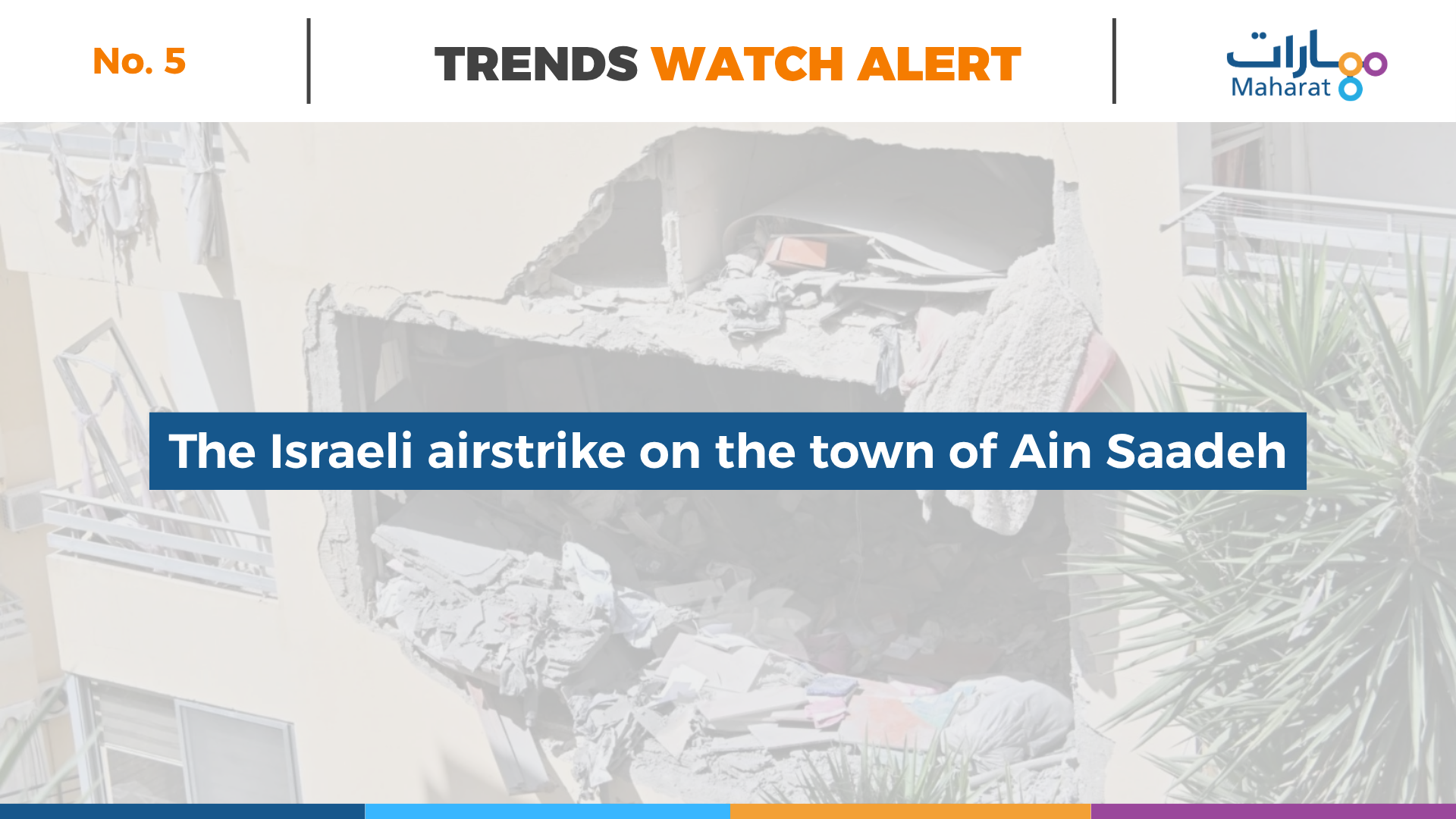
A missile strike targeted a residential apartment on Sunday, April 5, 2026, in the town of Ain Saadeh, Metn district, killing three people and injuring others.
Lebanese audiovisual media and most social media platforms, as usual, rushed to cover the incident, relaying testimonies from neighbors, eyewitnesses, and individuals present in the area. As a result, multiple and sometimes contradictory accounts emerged. The most common narrative was that Israeli missiles targeted a tenant on the fourth floor, but he was not harmed, and that neighbors saw someone fleeing on a motorcycle.
The owner of the targeted apartment, who arrived at the scene, denied that the apartment was rented—a claim also supported by the mayor. However, some media outlets reported interviews with individuals present at the scene who stated that a person had been frequenting the apartment and that it contained some belongings.
Media and online narratives varied and evolved throughout the day, making it difficult for the public to determine what had actually occurred, particularly given the inconsistencies. Nevertheless, a dominant narrative emerged in many comments: that Israel was responsible, that the primary target was a figure affiliated with Hezbollah’s social base, that the statements by the mayor and the apartment owner denying that the apartment was rented were “false,” and that responsibility lies with Hezbollah, as some of its members allegedly take shelter among civilians.
Why does it matter?
With its three victims, this incident took on significant national dimensions, unlike other strikes that resulted in far higher casualty numbers. This heightened attention was due first to its symbolic weight, and second to the political and social repercussions it generated. It was further amplified by a series of professional reporting errors, alongside narratives marked by hate speech, intimidation, accusations, and exaggeration. These dynamics extended the event beyond the security sphere, feeding into broader political debates concerning the state, the coexistence of Lebanon’s diverse communities, and the future of the Lebanese system.
An-Nahar published the following under the headline: “Escalation without restraint and mass assassinations… fears of breakdown after the Ain Saadeh breach”:
“The repercussions of the strike that hit an area in the heart of the predominantly Christian regions of Mount Lebanon quickly rose to the forefront of an already tense scene, attracting significant attention due to the high sensitivity of this development (...) Its consequences were not limited to fueling anger over victims who had no relation to a frightening conflict imposed on their areas, communities, and country, but went further to shaping bleak scenarios for the security and social situation in areas hosting displaced populations in general.”
What are the narratives?
The event is singular, while the narratives and accounts are multiple.
- The Lebanese Army statement
The Lebanese Army (Directorate of Orientation) issued two statements regarding the incident. The first, released on Monday, April 6, stated:
“A specialized unit of the army arrived at the site of the attack and conducted a field survey to collect evidence. It was found that the two missiles penetrated the roof of the building and then the fourth floor, and exploded on the third floor, which was the targeted floor. This resulted in the death of three civilians residing on the same floor, and the injury of others. Preliminary investigations also showed that there were no new tenants in the building. It was also found that a person was seen leaving the building on a motorcycle immediately after the attack; the investigation is ongoing to determine his identity and clarify the remaining details. The Army Command calls for avoiding speculation regarding this attack and for exercising awareness and responsibility pending the completion of the investigation.”
The second statement by the Army Command was issued the following day, Tuesday, April 7:
“As a result of investigations and security follow-up, it was found that the person who left the building on a motorcycle at the time of the attack and then disappeared is a delivery worker. In recent months, he had been delivering medicines to residents of one of the apartments in the building. In this context, the Army Command confirms the continuation of investigations to clarify the circumstances of the Israeli attack, and calls again to avoid speculation on sensitive security matters, which may lead to internal tensions.”
Nidaa Al-Watan newspaper questions the Army’s narrative:
“This incident places the file in the category of legitimate questions, pending transparent facts free from obfuscation and compromise. This ambiguity joins a series of previous incidents in which the security agencies did not provide a complete account, such as the rocket incident in Keserwan, the drone incident in Assia (Batroun district), and the rocket incident in Mar Roukoz–Dekweneh.”
The newspaper also reported that the person who fled on a motorcycle “was in direct contact with ‘associates,’ one of whom quickly blocked the road and intercepted a young man who tried to pursue him, thereby facilitating the suspect’s escape.” It further cited residents of the “Maronite project” who noticed suspicious nighttime movements in the targeted apartment.
Under the headline: “Ain Saadeh: the state is a bystander and the ‘ghosts of resistance’ infiltrate at night,” Nidaa Al-Watan wrote:
“The tragedy of the hills of Ain Saadeh has opened eyes to a bitter truth, one marked by deep disappointment among Lebanese citizens: the state they believe in and place all their hopes on continues to fail them, unable to protect them…(7 April 2026)
In another article in Nidaa Al-Watan, Rami Naim wrote:
“The Ain Saadeh explosion was not a turning point in the war between Israel and Hezbollah, but rather a major turning point within Lebanon itself, exposing the gap between those who have been deceiving one another since 1920 under the slogans of coexistence, shared living, and national unity(…). Until the circumstances of this incident and others are fully clarified, the essential step remains the formation of a genuine Lebanese core that not only rejects Hezbollah’s weapons and policies, but also reconsiders the structure of this entity, first in terms of its system and second in terms of its form. It is now impossible to sustain the illusion of coexistence between two mutually hostile sides. It is also impossible to continue patching up fundamental disagreements or dismissing what happened as a ‘summer cloud,’ when every year brings a new summer and new clouds.”
Samir Geagea stated:
“What happened does not require much interpretation… The Israelis were targeting a member of the Quds Force, and a strike was directed at an old building, which led to the collapse of the ceiling onto the home of our comrade Pierre Mouawad. What is known as the deep state in Lebanon—namely the Lebanese Army, Internal Security Forces, and the judiciary—preferred to let some Lebanese people go toward self-destruction and disaster instead of confronting them, considering that taking responsibility from the outset would have been better for everyone. He also noted that the atmosphere in recent days included significant alarmism regarding the possibility of a civil war…”
Geagea also warned about the trust gap between Lebanese citizens and the “deep state”:
“Seventy-five percent of Lebanese are committed to the state, but the state has abandoned its commitment to them, which is unacceptable and may push people, unwillingly, to abandon their belief in the state project.”
- Al-Akhbar newspaper (8 April)
Maysam Rizk wrote under the title: “Geagea Seeks a Spark: Sedition to Meet Missiles”:
“In the small details lie the outlines of the larger project. In the case of the enemy strike targeting an apartment in Ain Saadeh, the event, for Maarab and those aligned with it, was not the killing of the Lebanese Forces official Pierre Mouawad and his wife by Israeli fire, but rather the concern over how the narrative would be managed. The media machine quickly moved to construct a lengthy narrative aimed at removing responsibility from the perpetrator, out of fear of losing an opportunity to exploit blood in service of a project seeking to turn internal strife into an alternative to Israeli missiles after the end of the war.”
“A pre-prepared narrative was quickly promoted, claiming that the apartment had been rented to an ‘unknown’ or ‘foreign’ person, before moving on to linking him to Hezbollah…”
The incitement allegedly practiced by Maarab and its tools in exploiting and politicizing the incident comes, according to the article, within a dangerous project driven by Geagea’s agenda, based on the following:
“First, frightening host communities from displaced populations in order to incite hostility against them and push for their expulsion.”
“Second, undermining the concept of the state in order to promote the idea of self-security.”
“Third, reinforcing the idea of rejecting the stranger and the other, which Geagea exploits to support his isolationist projects, under the pretext of an existential threat (…).”
“Based on what happened in Ain Saadeh, it can be concluded that Samir Geagea is still striving to seize an opportunity for internal explosion.” (Al-Akhbar, 8 April 2026)
Other reactions
Social media platforms and news websites were flooded with comments and reactions to the incident, which varied in their directions and content.
The comments on the incident reflected highly polarized interpretations. Some emphasized state failure and called for stronger security measures, including emergency steps. Others blamed Hezbollah for exposing civilians to risk, while others focused on Israel’s responsibility. A further set of comments advanced conspiracy narratives.
Elements of distortion used?
The Ain Saadeh strike represents a case study in how an incident can be transformed into a national-scale event, becoming an embodiment of deep internal divisions and conflicting views regarding authority and the state. It also illustrates numerous examples of fear-mongering, incitement, hate speech, and accusatory discourse, in addition to misleading, inaccurate, and propagandistic media coverage.
- At the level of media coverage:
It became difficult for the Lebanese public, following events through media outlets and social media platforms, to determine what actually happened, given the contradictory reports, eyewitness accounts, and the blending of news and commentary. Many journalists offered interpretations based on personal beliefs rather than verified information from the scene. Most media outlets appeared driven by the need to satisfy public demand for immediate information at the expense of accuracy. Moreover, “opening the airwaves” to unverified witnesses or opinions risked undermining the investigation and spreading false information.
- At the level of hate speech and incitement:
There was a renewed rise in rhetoric inciting hostility toward displaced populations and promoting the idea that they may pose a threat to host areas. This generalization contradicts ethical and professional standards and contributes to spreading fear and hatred of the other. Fear is further amplified when confidence in the ability of security forces to maintain order is questioned, leading citizens to feel abandoned. This, in turn, encourages the notion of “self-protection,” which contradicts the concept of the state and threatens civil peace.
- At the national level:
Trends emerged in the prevailing discourse that contradict national concepts: targeting and casting doubt on the security forces, questioning the state and its officials, and accusing them of failure or conspiracy. In addition, in the discourse of Hezbollah and that of its opponents, mutual accusations of treason, “exploitation of blood,” and “serving the Israeli enemy” emerged, reaching the point of both sides threatening each other and questioning the state’s ability to continue in its current form.
Possible implications
As events unfold, the political discourse deepens its divisions and mutual accusations intensify. Narratives of treason, incitement, and hate speech become normalized in daily language, entering both media discourse and public vocabulary. This suggests that such discourse is not merely the result of occasional professional or ethical lapses, but rather a deliberate tool serving competing political projects. A discourse that undermines the state and its institutions, questions the security forces, accuses officials of treason and failure, and simultaneously promotes fear of the “other” — no longer seen as a fellow citizen but as an enemy and a threat — ultimately leads to the emergence of new conflicts.