10 April 2026
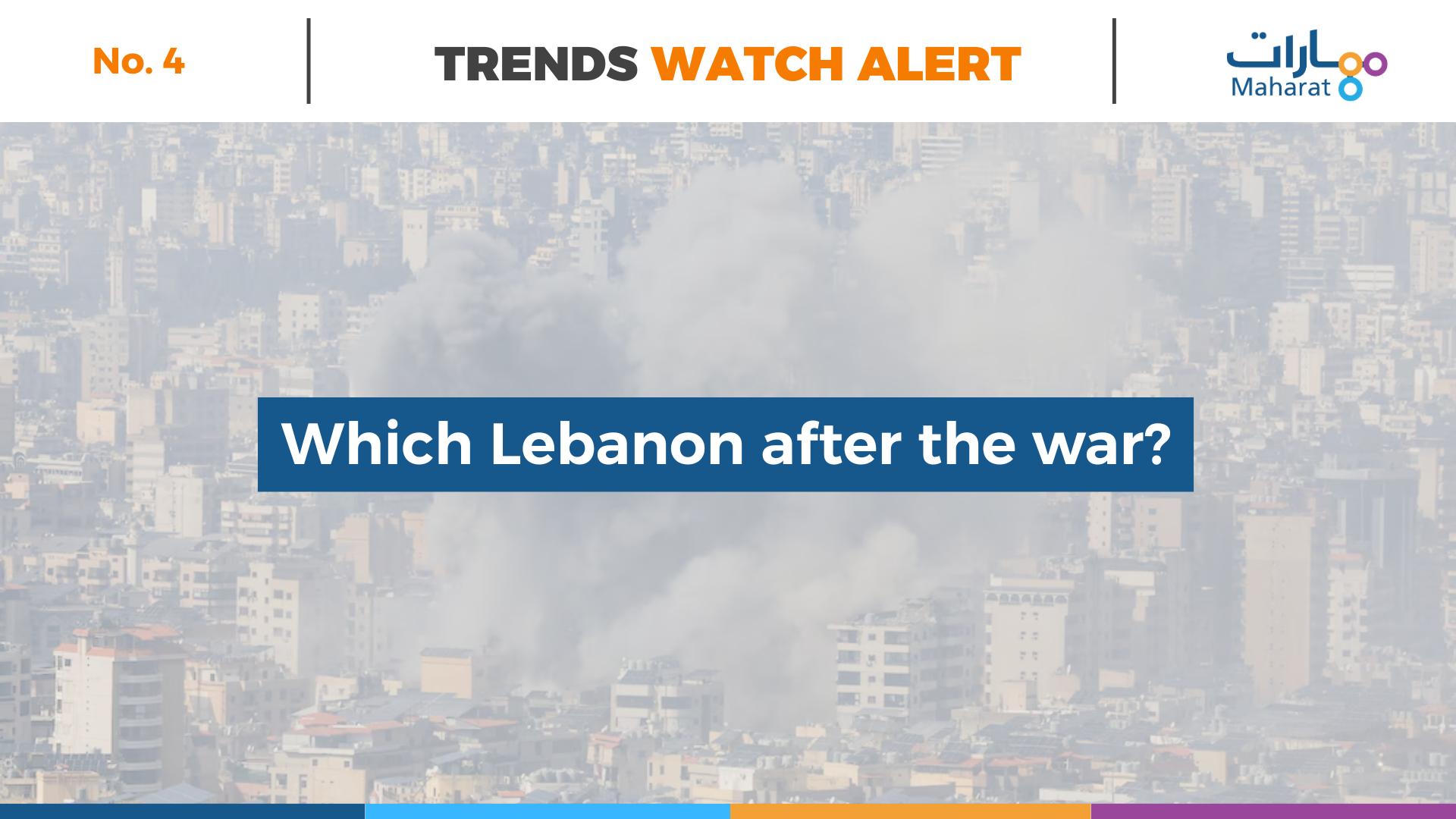
Trends Watch Alert - April 8, 2026
The ongoing war in Lebanon and the broader Middle East has caused a deep divide within Lebanese society regarding this war, its causes, and the responsibility of the parties involved. This internal division is not limited to this issue; it has extended to many domestic topics and positions, so that numerous Lebanese affairs and various political, social, and other stances have become axes of alignment, disputes, and conflicting narratives. Added to this are numerous violent and inflammatory speeches, as well as distorted or false news, which exacerbate internal divisions.
Therefore, this project monitors social and political discourse in the public sphere by following issues that media outlets, social media platforms, and influencers prioritize, with the aim of shedding light on them, tracking their narratives, understanding who stands behind them, and assessing the risks they carry. These topics often reflect societal trends and reveal the positions of key actors regarding them.
1- What is the trend?
Day by day, the ongoing war is deepening the internal divide between those who support Hezbollah as a resistance movement against Israel and those who hold it responsible for the war, accusing it of dragging Israel into it. Both sides are now raising the question of the “day after” the war, as are many journalists and intellectuals. Pro-Hezbollah media continues to criticize the government of Prime Minister Nawaf Salam, which has stripped the party of its “resistance” label and considers it illegal.
Such media now describes it as a “Vichy government” (in reference to the French government during World War II that collaborated with Nazi Germany), and labels some of its opponents as embodying “Lebanese Zionism.” These accusations carry significant risks and further inflame internal conflict.
Meanwhile, many positions emerging from the party’s opponents highlight the difficulty of coexisting with it and cast doubt on the continuation of Lebanon in its current form or under its current system. The central question thus becomes: where is Lebanon heading, and what will the “day after” the war look like?
2- Narratives accompanying the issue
Hezbollah continues to accuse the government of Nawaf Salam of treason, describing it as a “Vichy government.” It also labels its opponents as “Lebanese Zionism,” while maintaining that the only solution to the ongoing war lies in resisting Israel. At the same time, it portrays itself as the victim of a conspiracy led by its opponents.
Meanwhile, Hezbollah’s adversaries persist in accusing it of having dragged Israel into a war with Lebanon, and view its political and social positions as a threat to the country. This contradiction between the two discourses is laden with threats, accusations of treason, and incitement.
- Accusations of treason against the government and the opposition
Under the headline “The Vichy government deepens its treason: a letter to the United Nations to cover the aggression against Lebanon,” Marwan Abu Haidar wrote in Al-Akhbar on 1 April 2026:
Marwan Abu Haidar argues in Al-Akhbar that, despite escalating Israeli threats, the Lebanese government is focusing on placing resistance “outside the law” by officially classifying the military wing of Hezbollah as illegal in a letter to the UN Security Council.
The letter calls for banning the group’s military activities, disarming it, and restricting it to political action. He warns that this step goes beyond a procedural measure, as it could provide legal and political justification for Israeli attacks by framing them as actions against an outlawed entity, thereby justifying Israeli attacks and occupation.
Also in Al-Akhbar (issue of 2 April 2026), Karim Haddad argues that Lebanese Zionism is” not a simple phenomenon that can be reduced to accusations or slogans; rather, it is a complex political–intellectual structure that goes beyond religious affiliation or sectarian identity, and is positioned within a network of interests, discourses, and alignments that have historically formed in modern Lebanon.”
“After the end of the war, and with shifts in the international and regional environment, it reproduced itself within a new discourse: the discourse of the ‘state,’ ‘legitimacy,’ and the ‘monopoly of arms.’ In this discourse, the goal is no longer defending Israel, but redefining the conflict with it. The problem is no longer the occupation, but the ‘reaction’ to it. The danger is no longer aggression, but resistance (...) Lebanese Zionism, therefore, does not operate only through political alliances, but through the reproduction of language. It works at the conceptual level: turning ‘resistance’ into a ‘problem,’ ‘aggression’ into a ‘context,’ and ‘surrender’ into ‘realism.’”
3- What is the importance of the topic?
- The future of living together
Articles and public statements increasingly question Lebanon’s ability to continue in its current form, given the deep internal divisions. Alternative options for a new political system are being discussed, as well as questions about whether the Lebanese people can rebuild a unified nation despite the many obstacles surrounding them. These debates heighten Lebanese citizens’ anxiety and fear about the future and what it may bring.
Ali Hamadeh, writing in An-Nahar under the headline “The Time Has Come to Think of Another Lebanon”:
“(…)Citizens do not feel that the state or the security and military agencies act with sufficient firmness to repel provocations and foster reassurance in the neighborhoods and streets of the capital. This reality represents a heavy burden on the country. It will cast a shadow over the perspectives of millions of Lebanese from other communities who reject everything represented by the aforementioned party (Hezbollah)—its politics, security, culture, and way of life. After the war, a serious and profound discussion will begin on the fate of living together under one roof. The ‘Hezbollah project,’ which we expect will remain active after the war, must be scrutinized in light of the national project and Lebanon’s future. The unity of Lebanon under the current system must be placed on the table for a calm discussion, based on the premise that it is no longer possible to coexist with this project, which is dangerous to all Lebanese, nor even with a softened version of it (…) The time has come to think of another Lebanon.” (An-Nahar, 2 April 2026)
Dr. Qusai Al-Hussein, writing in Al-Liwaa under the headline “Crime United Us”:
“We do not need many proofs, nor are we lacking evidence, to see that the Lebanese have been divided since the very beginning of independence. Perhaps it is not an exaggeration to say that this was the case even during Ottoman rule and throughout the French mandate. They never formed a single nation, nor were they a single people, even if they shared the same religion or sect…” (Al-Liwaa, 2 April 2026)
Brigadier General (Ret.) Tony Abi Samra wrote in Nidaa Al-Watan under the headline “Lebanon Between Ideology… State Failure and the Federalism Option”:
“Today, Lebanon faces a decisive historical moment, which goes beyond being a passing political crisis to becoming an existential crisis in every sense of the word. What the country is experiencing is no longer merely a stumble in governance or temporary disagreements among political forces; it has turned into a structural crisis that strikes at the very foundations of the state itself(…).The disagreement is no longer a traditional political dispute over power or interests but has become a conflict of narratives, identities, and contradictory discourses, and even a religious–doctrinal struggle(…). Each party becomes convinced that it is not defending only an interest, but a ‘divine right,’ which undermines the logic of compromise and turns politics into an open confrontation(…)”
“Since its establishment in 1936, the Lebanese system was designed to manage pluralism, but over time it has failed to achieve this goal(…) Each community now has its own narrative, heroes, and reading of history. Thus, there is no longer an effective overarching framework to regulate this diversity. Under the title ‘The Illusion of Lebanese Nationalism,’ the author adds: ‘For decades, “Lebanese nationalism” was presented as a solution that transcends sects and divisions. But after nearly a century, it is clear that this project has not been realized in practice. There is no unified, agreed-upon history book, no shared definition of friend or foe, and no national symbols that unite all Lebanese(…)’”
“In this context, federalism emerges as a structural option—not as a divisive proposal, but as a mechanism to organize and manage pluralism (…)Today the question is no longer: How do we fix the current system? Rather, it has become: Is this system fundamentally capable of being reformed?” (Nidaa Al-Watan, 1 April 2026)
Marc Saikaly wrote on Ici Beyrouth under the headline “The End of Greater Lebanon?”:
“The countdown has begun, and Hezbollah is the one who started it. One hundred and six years ago, France, as the mandate power, declared the establishment of ‘Greater Lebanon’—a state born of a geographic and sectarian compromise, fragile by nature, but real in its ambitions. Today, this state is being carved up while still alive. Let us present the facts without evasion. The ceasefire in November 2024 was dead from the start, struck down by Hezbollah itself. The Iran-aligned militia refused to disarm and refused to withdraw, and while the ink was still drying on the agreements, the Iranian Revolutionary Guard was working behind the scenes to reshape them in terms of personnel, weapons, command structures, and finances(…)”
“The result: Israel now operates militarily up to forty kilometers inside Lebanese territory. The great powers have no justification to prevent it (…). Meanwhile, in the East, the Damascus army is watching. It is waiting. Perhaps the final green light from the United States for entering the Bekaa is still just a decision in preparation. It must also be said that Hezbollah is doing its utmost to provide Syria with a pretext to enter Lebanon(…). So what will remain then? Mount Lebanon. An urban and mountainous pocket, rich in memories, but cut off from its south, its plains, and its eastern borders. This will no longer be Lebanon.”
“(…)The Lebanese state does not have the luxury of hesitation. Controlling Hezbollah’s weapons, positions, and military infrastructure across the country is not just one option among others in the game of sectarian balances. It is a condition for the country’s survival within its 1920 borders. And if the Lebanese state cannot achieve this on its own, which seems clear, it must have the courage to ask the world for assistance (…). As Georges Bernanos said: ‘A country without a state is nothing more than land.’” (Ici Beyrouth, 2 April 2026)
Jerry Maher, writing in Al-Liwaa under the headline “Sovereignty Cannot Be Restored by Half a Decision”:
“(…) In 1966, the state did not hesitate (to expel the Iranian ambassador from Lebanon) and did not compromise on its decision. Today, however, what is required is not only the restoration of that decision but the ability to implement it fully. Sovereignty, in the end, cannot be divided, cannot be exercised through statements, and cannot be restored by half a decision. The expulsion of the Iranian ambassador today must be understood in this context: it is not an exceptional event but a continuation of a clear precedent. Yet this precedent is only complete if the procedures are fully carried out(…) Retraction, hesitation, or silence about what happened would mean only one thing: the problem was never the ambassador(…) but the state’s ability to be a state.” (Al-Liwaa, 2 April 2026)
Dr. Antoine Massara, writing in Nidaa Al-Watan: “‘And if Israel did not exist’—or the source of the state’s illness is Lebanese!”
“(…) Many will continue to repeat familiar posturing regarding the Israeli enemy. The planting of a divinized ethnic Zionist nationalism in the region in 1948 is the source of unrest and wars, not only for Lebanon but also for today’s world and the depth of the United Nations’ crisis.
(…) Enough posturing by parroting intellectuals who offer abstract analyses unrelated to reality, along with academics behind desks, ideologues, deceivers, and gamblers! It is neither the issue of Palestine nor resistance alone that is the source of repeated disasters! The source lies in the ideologies of gamblers and deceivers who exploit diseased mental structures and scattered memories, which have not learned lessons, for the purpose of internal domination, while reviving deadly and suicidal adventures for themselves, the small homeland, and their grand ambitions (…) The multinational wars in Lebanon from 1975–1990 were the impossible effort to dismantle a united and plural Lebanon.
“Israel, in the political activity of reckless and adventurous Lebanese politicians, is simultaneously an enemy and a pretext: a pretext to exercise factional dominance in Lebanon, a reason to cover Assad’s system’s dominance without seeking to liberate a single square meter of the Golan, and a pretext for a regional system led by clerics to kill the state while planting proxy states in Lebanon, Syria, Iraq, Yemen, and Sudan(…)?” (Nidaa Al-Watan, 2 April 2026)
4- Elements of Distortion
The narratives presented above reflect the deep divisions currently prevailing in Lebanon. However, the discourse carries a great deal of threat, incitement, and hostility, which is reprehensible, negatively affecting social and political life, generating anxiety and fear among citizens, and later hindering the necessary convergence between the country’s components. Some narratives from both sides now cast doubt on the possibility of such convergence. Labeling the other as “Zionist” places them on the level of an enemy, especially as Hezbollah increasingly sees internal adversaries conspiring against it. Similarly, Hezbollah’s opponents perceive it as a threat comparable to that of the external enemy, posing a danger to coexistence and the building of shared life. Accordingly, the narratives ask: how will the day after the war look?
5- Potential Implications
Notably, Hezbollah supporters and opponents converge on one point: both criticize the authorities, holding them responsible for current events, albeit from different perspectives. Hezbollah calls on the authorities to support “resistance,” while its opponents see the authorities as weak for failing to resolve the monopoly of weapons and to reclaim the decision over peace and war from the hands of the “Hezbollah militia.” Consequently, the authorities—who are supposed to serve as a refuge for various parties, a point of convergence, and a guarantor of civil peace and law enforcement—appear instead to be the problem. It was notable that the news website Trust Media Lebanon labeled the government of Nawaf Salam as a “De Gaulle government.”