27 March 2026
Trends Watch Alert - March 2026
The ongoing war in Lebanon and the broader Middle East has caused a deep divide within Lebanese society regarding this war, its causes, and the responsibility of the parties involved. This internal division is not limited to this issue; it has extended to many domestic topics and positions, so that numerous Lebanese affairs and various political, social, and other stances have become axes of alignment, disputes, and conflicting narratives. Added to this are numerous violent and inflammatory speeches, as well as distorted or false news, which exacerbate internal divisions.
Therefore, this project monitors social and political discourse in the public sphere by following issues that media outlets, social media platforms, and influencers prioritize, with the aim of shedding light on them, tracking their narratives, understanding who stands behind them, and assessing the risks they carry. These topics often reflect societal trends and reveal the positions of key actors regarding them.
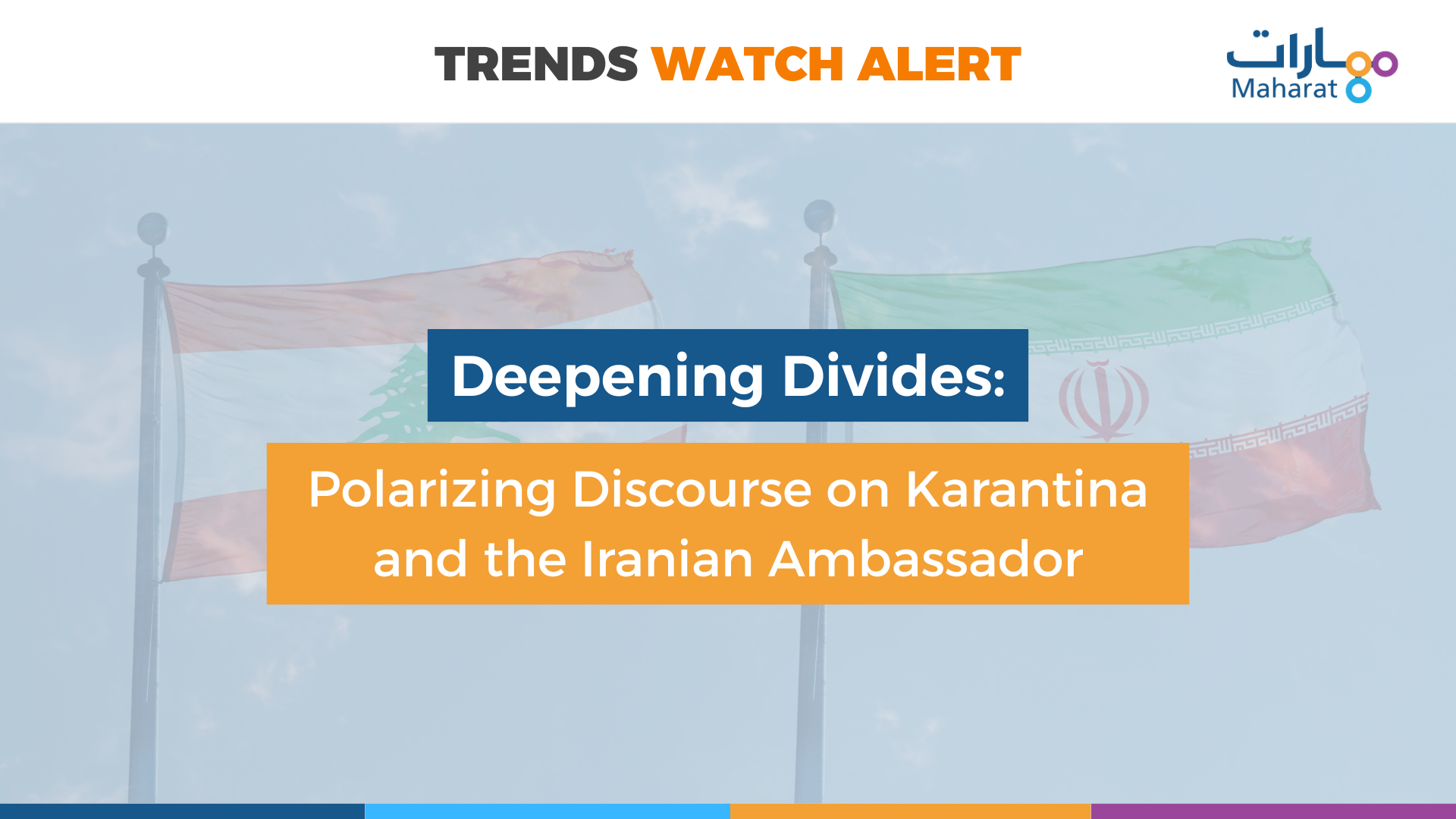
This analysis examines two illustrative cases: the expulsion of the Iranian ambassador and the Karantina shelter center project, showing how discourse, historical memory, and media framing amplify tensions and fuel polarization.
Case 1: Expulsion of the Iranian Ambassador
What’s the Trend?
The decision by Lebanese Foreign Minister Youssef Raggi to request that the ambassador of the Islamic Republic of Iran, Mohammad Reza Sheibani, leave Lebanon constituted an exceptional event, given the close relationship between Hezbollah and Iran and considering the delicate circumstances Lebanon and the region are experiencing. A source in the Ministry of Foreign Affairs stated that the decision was made “after coordination and consultation with the President and the Prime Minister.”
The “sovereignist” parties praised the decision, considering it “a historic step toward restoring Lebanon’s freedom of decision.” Meanwhile, the Shiite political and religious leadership condemned the decision and called for its reversal.
Narratives and Reactions:
Supporters:
- Political figures and media framed the decision as a restoration of Lebanese sovereignty.
- Headlines portrayed Iran as interfering or occupying, e.g., Nidaa Al-Watan: “Ambassador of the 'Nest of Terror' expelled from Lebanon.”
Opponents:
- Decision opponents, including Al-Akhbar newspaper, Hezbollah, Shiite religious leaders and other political figures portrayed it as dictated by external powers and serving the enemy.
- Some of the opponents also argued that it threatened national unity and risked inciting sectarian strife.
Elements of distortion used in discourse:
- The discourse was confrontational from both sides.
- Hezbollah opponents labeled the Iranian embassy a “Nest of Terror” and emphasized Revolutionary Guard interference in Lebanese internal affairs to justify expelling the ambassador.
- Opponents of the decision portrayed it as dictated by external powers, serving the enemy, threatening national unity, and inciting sectarian strife.
Potential Implications:
- Highlights the conflict between authorities aiming to restore sovereign decision-making and Hezbollah, which considers resistance legitimate.
- Division exists both in public opinion and within the executive branch, with Shiite ministers opposing the decision.
- Raises the risk of major political consequences.
- Political discourse included explicit threats, suggesting possible attempts to overturn the decision by other means, including street action.
Case 2: Karantina Shelter Center
What’s the Trend?
The “Disaster Risk Management Unit,” responsible for displaced persons from war zones, decided to establish a center in the Karantina area at the northern entrance to Beirut. Construction began, and the center is almost ready, reportedly intended to host displaced persons.
However, a strong campaign opposing the project emerged, involving politicians, parliamentarians, journalists, and influencers, accompanied by threats and intimidation with national dimensions. It is not an exaggeration to say that most of the discourse carried a wartime atmosphere.
Narratives and Reactions:
Opponents:
- Framed the shelter as a security threat or political maneuver to control Beirut, recalling civil war memories of Karantina and Tel al-Zaatar.
- Concerns included demographic change, military encirclement, and the creation of a new security hub.
- Notable statements:
- “We will not accept turning Karantina into a security hub”
- “Beirut can no longer tolerate poorly considered decisions”
Responses:
- Framed fears about the displaced as rooted in concerns over demographic change, which reflects a rejection of “the other.”
- Warned against escalating incitement and fear-mongering, urging state intervention to combat incitement and intimidation.
Elements of distortion used in the discourse
- Evoking the civil war
- Recalling the camps’ transformation into frontlines
- Threats, exaggeration, and intimidation
- Depicting a conspiracy to encircle the Christian area
- Portraying the project as creating a new security hub
Potential Implications:
- Deepening of the national divide.
- Erosion of mutual trust among citizens as members of the same nation.
- Fundamental challenge: how can a country be built from communities that fear one another?
- Diminished confidence in the state and its capacity to ensure the protection of all regions.
These tensions ultimately prompted the authorities to retract the project. The Disaster Risk Management Unit at the Prime Minister’s Office clarified:
“Contrary to circulating reports, the Disaster Risk Management Unit at the Prime Minister’s Office confirms that all rumors about the site being prepared in Karantina are false. The unit clarifies that the site is being prepared as a precautionary measure, not for immediate use, and its intended purpose has not yet been determined.”
Common Patterns Across Both Cases
1. Polarization and Deep Divides:
Both cases show Lebanon split along political and sectarian lines, with sharply opposing narratives.
2. Media and Public Discourse Amplification:
Both events highlight how public discourse, media framing, and influential actors intensify fears and division.
3. Historical Memory and Symbolism:
The civil war (1975–1990) shapes public perception in both scenarios: Karantina echoes past violence, while the ambassador’s expulsion recalls sovereignty struggles.
4. Trust and Legitimacy:
Citizens’ and communities’ trust in the state is weak, with suspicions of external influence (Iran, U.S., Saudi Arabia, etc.) in both cases.
5. Potential Risks:
- Threats to national unity, social cohesion, and institutional trust.
- Increased risk of conflict escalation, either through political channels or public mobilization.