19 December 2025
Protecting Information Integrity in Light of the 2026 Lebanese Elections
Lebanese Internet Governance Forum
Session title: Protecting Information Integrity in Light of the 2026 Lebanese Elections
Organized by: Maharat Foundation
Session moderator: Journalist Walid Abboud
Speakers:
Elissar Naddaf – Board of Directors Chair and Director General- Télé Liban
Guilnard Asmar – Media & Communication Officer, United Nations Development Programme (UNDP) - Lebanese Elections Assistance Project
Ghassan Moukheiber – Former Member of Parliament and Legal Expert
Nasri Masserra – Head of the Sociology and Communications Department, Saint Joseph University (USJ)/ International Expert in Digital Communication
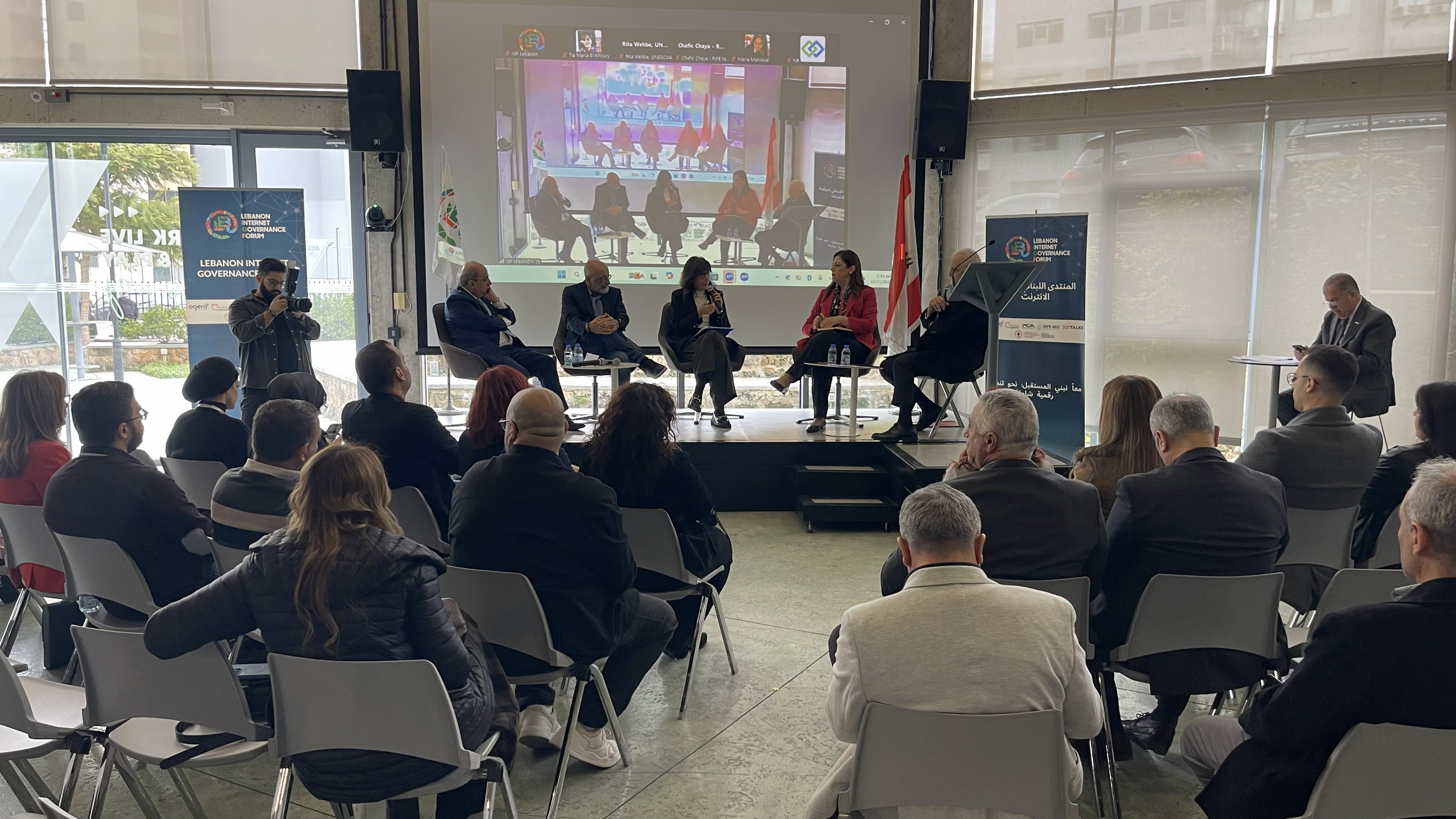
As part of the Lebanese Internet Governance Forum held at Beirut Digital District, Maharat Foundation organized a panel titled “Protecting Information Integrity in Light of the 2026 Lebanese Elections” on 11 December 2026. During the session, speakers discussed the growing challenges associated with technological developments, the spread of disinformation, and deepfakes, and addressed the role of public media and civil society, as well as the need to develop legal frameworks that serve to protect the integrity of information, particularly in the context of the electoral process.
The floor was opened for questions and audience interventions, after which the session concluded with a set of key messages and recommendations that provide a foundation for ensuring information integrity overall, particularly during the parliamentary elections.

First: The Role of Public Media in Protecting Information Integrity
The session opened with a discussion on the role of public media in safeguarding information integrity. Elissar Naddaf, Chair of the Board and Director-General of Télé Liban, considered that ensuring and protecting information integrity is a fundamental condition for guaranteeing transparency in parliamentary elections. She stressed that disinformation poses a direct threat, particularly in contexts of crises and wars, given its impact on civil peace and on the public image of candidates.
She explained that Télé Liban, as a public media outlet, works to ensure equal opportunities for all candidates without discrimination, to combat false information by adopting verification mechanisms, training staff in fact-checking, and relying on the National News Agency as an official reference for information.
Naddaf emphasized that the independence of public media prevents the adoption or political instrumentalization of disinformation and rumors against specific candidates. She noted that such information has become a societal issue, but that the responsibility of national media lies in not being drawn into it and in correcting it.
With regard to electoral advertising, Naddaf affirmed that Télé Liban, as a public broadcaster, rejects paid political advertising, as it undermines the principles of equality and democracy. She called instead for free and equal airtime that allows citizens to review candidates’ platforms without financial or political influence.
She also pointed to structural changes within Télé Liban, including the elimination of news introductions that, in her view, previously contributed to shaping public opinion or promoting misinformation and disinformation.

Second: The Role of Civil Society in Combating Disinformation
Guilnard Asmar, Media & Communication Officer at the United Nations Development Programme (UNDP), explained that civil society is capable of playing a pivotal role in combating misinformation and disinformation through partnerships and awareness-raising projects.
She noted that UNDP works with media institutions, including Télé Liban and the National News Agency, on campaigns to raise awareness about the electoral law and promote electoral education. This includes the creation of a Fact-Checking Desk in collaboration with university students to monitor, verify, and publish information via the National News Agency, in cooperation with the Ministry of Interior and the Ministry of Information. UNDP also supports the Supervisory Commission for Elections by training volunteers to monitor traditional media and social media platforms, issuing periodic reports under the authority’s supervision, thus enabling it to fulfill its oversight role during the parliamentary elections.
Asmar also emphasized the importance of civic education, particularly through work with schools and youth, to instill concepts of transparency, democracy, and accountability. She considered that early awareness forms a crucial line of defense against disinformation.
Third: Technical and Digital Challenges
During the panel, regarding technical and digital challenges, Nasri Masserra, Head of the Sociology and Communications Department at Saint Joseph University, presented findings from media monitoring studies conducted during previous parliamentary elections. He explained that verifying information requires time, while the spread of disinformation is extremely fast, particularly with artificial intelligence and deepfake technologies.
The study also showed that WhatsApp is the most widely used platform for disinformation, due to the difficulty of tracing sources and tracking the spread. On other platforms, data can be purchased and analyzed to identify the entities that released misleading content.
He noted that monitoring teams are capable of verifying information within 24 hours. For instance, during a previous election, about 3 million tweets were monitored. However, the financial cost is high, which leads to adopting a sampling methodology instead of full-scale monitoring to avoid excessive expenses.
Masserra also highlighted the danger of coordinated digital campaigns, citing the spread of around 80,000 tweets targeting activist Lokman Slim just days before his assassination.

Fourth: Legal Framework for Protecting Information Integrity – Between Law and Implementation
Former MP and legal expert Ghassan Moukheiber distinguished between the Media Law and the Electoral Law, explaining that addressing false news during election campaigns primarily falls under the Electoral Law.
He emphasized that the main problem is not the absence of legal texts, but rather the lack of enforcement. He criticized the Supervisory Commission for Elections for failing to refer violations to the judiciary, highlighted the inaction of competent judicial authorities in issuing deterrent decisions against offenders, and noted that the Constitutional Council does not fully exercise its role when violations affecting election results are proven.
Regarding the proposed new Media Law, which is expected to move from committee stage to the general assembly for a vote soon, Moukheiber noted that the proposal addresses disinformation through civil provisions adjudicated by civil courts, while abolishing imprisonment for all cases related to freedom of opinion and expression. He also stressed that, in his view, deepfakes constitute a form of forgery.
Additionally, the proposed law provides for the creation of an independent national media council, tasked with developing ethical codes of conduct and evaluating media performance during both ordinary and electoral periods.
Moukheiber underscored that there can be no state without the enforcement of laws, calling on media outlets to uphold their ethical responsibilities, especially in light of the collusion of some media institutions with the political class.
Fifth: Emerging Issues – Online Voting and Artificial Intelligence
Participants also discussed another dimension introduced by digital developments: online voting, where serious concerns were raised regarding data protection, the possibility of manipulation, and the difficulty of assessing its impact on voters’ choices, particularly given the lack of a legislative framework for data protection in Lebanon.
Summary and Recommendations
The panel’s contributions converged on the view that protecting information integrity, particularly in the 2026 parliamentary elections, requires a comprehensive approach that intersects media, legal, technical, and educational dimensions. The challenges are not merely theoretical, especially in light of the rapid evolution of technological tools that facilitate the production and spread of misleading information.
The panel highlighted several recommendations to strengthen and protect information integrity in light of the upcoming parliamentary elections:
- Enhance media and digital literacy in schools and integrate media and information education into curricula to combat disinformation.
- Strengthen the role of public media and ensure its full independence, given its role in ensuring fair representation and equality among candidates, and in providing free airtime without reliance on paid political advertising.
- Political will is needed to ensure that the Electoral Supervisory Authority can perform its oversight function, alongside providing it with the necessary resources and powers, and enabling it to draw on expertise in digital governance and the protection of information integrity during elections.
- Enforce existing laws, particularly the Electoral Law, to regulate the electoral process, including election-related media, and combat disinformation.
- Adopt the new Media Law as a structural reform, including the establishment of an independent National Media Council.
- Expand fact-checking initiatives through partnerships between public and private media, universities, and civil society.
- Prepare in advance for risks posed by artificial intelligence and deepfakes by developing technological tools, fostering collaboration among all stakeholders, and adopting proactive approaches to promote critical thinking in information consumption.