19 March 2026
Media Crews Under Threat: Between the Fires of War and Domestic Pressures
The Geneva Conventions and the Additional Protocol I constitute the fundamental framework for the protection of journalists during wars and armed conflicts. This is explicitly stated in Article 79 of the Protocol, which considers journalists as civilians entitled to direct protection, provided that they do not take part in hostilities.
Deliberately targeting journalists is also considered a war crime under the Rome Statute of the International Criminal Court. Protection rules further emphasize the need to enable journalists to carry out their work freely and to ensure accountability for violations committed against them, in order to prevent impunity.
War and Attacks Without Deterrence
With the return of the open war waged by Israel against Lebanon, targeting various Lebanese regions from southern Lebanon to Beirut and the Bekaa, the issue of journalist protection has once again come to the forefront. This raises questions at the level of both the national and international legal frameworks, as well as the role of the state, media institutions, and journalists themselves in ensuring the highest levels of protection. All of these dimensions, however, collide with the field reality and the risks resulting from Israel’s violations of all conventions and agreements that protect journalists and civilians.
These violations have been evident since the beginning of the Israeli war on Lebanon on 8 October 2023, as journalists were directly targeted in coverage areas. This led many media teams to withdraw from frontline locations, creating significant challenges in accessing information and affecting the reliability of information. Israeli attacks on journalists were also accompanied by internal conditions in some areas that did not contribute to providing a suitable environment for journalists’ work and restricted their access to information.
Maharat Foundation had previously published a report highlighting the risks faced by journalists during the Israeli war on Lebanon, particularly due to direct targeting and repeated attacks against some of them while covering events.
These attacks, along with domestic pressures and harassment, have reduced the capacity for field reporting and limited access to information in conflict areas. Many journalists have also faced additional challenges related to displacement and difficult living conditions, which have affected their ability to perform their professional duties.
The report emphasized that the continuation of these violations not only endangers the safety of journalists, but also undermines the public’s right to access information and to document war-related abuses. It therefore underscored the urgent need to strengthen the protection of journalists and to activate accountability mechanisms to prevent impunity for those responsible for these attacks.
Today, with the return of war, it has become necessary to revisit and further shed light on the issue of protecting journalists and media institutions. This requires a deeper examination of the challenges and gaps that journalists face in accessing information, drawing on testimonies from legal experts and field reporters, and situating these within both the international legal framework and the local reality imposed by the war.
International conventions, frameworks, and protocols exist, yet protection is missing
The Geneva Conventions and the Additional Protocol I constitute the primary legal framework for the protection of journalists during wars and armed conflicts. Article 79 of the Protocol explicitly affirms that journalists are considered civilians and are entitled to direct protection, provided they do not take part in hostilities.
In addition to these instruments, several resolutions, action plans, and reports, were referenced in an article by The Legal Agenda. These include:
- United Nations Security Council Resolutions 1738 (2006) and 2222 (2015), which stress the need to protect journalists and media workers during armed conflicts and wars.
- A series of Human Rights Council resolutions, including resolution 59/15, emphasizing states’ obligations to protect journalists, ensure investigations into crimes committed against them, and hold perpetrators accountable, noting that impunity remains one of the main drivers behind continued attacks on the press.
- The United Nations Plan of Action on the Safety of Journalists and the Issue of Impunity, which calls for concrete measures to protect journalists, strengthen accountability for crimes committed against them, and raise awareness about the importance of their safety as a fundamental condition for freedom of expression and democracy.
- Reports of the Special Rapporteur on freedom of opinion and expression, which underline that attacks against journalists constitute a direct threat to freedom of expression, and that media cannot operate freely and independently in an environment of fear and intimidation.
Deliberately targeting journalists is also considered a war crime under the Rome Statute of the International Criminal Court. These frameworks further stress the necessity of enabling journalists to perform their work freely and ensuring accountability for violations committed against them to prevent impunity. However, the effective implementation of these protections on the ground remains a major challenge in many contemporary conflicts.
Ongoing threats to journalists and media institutions
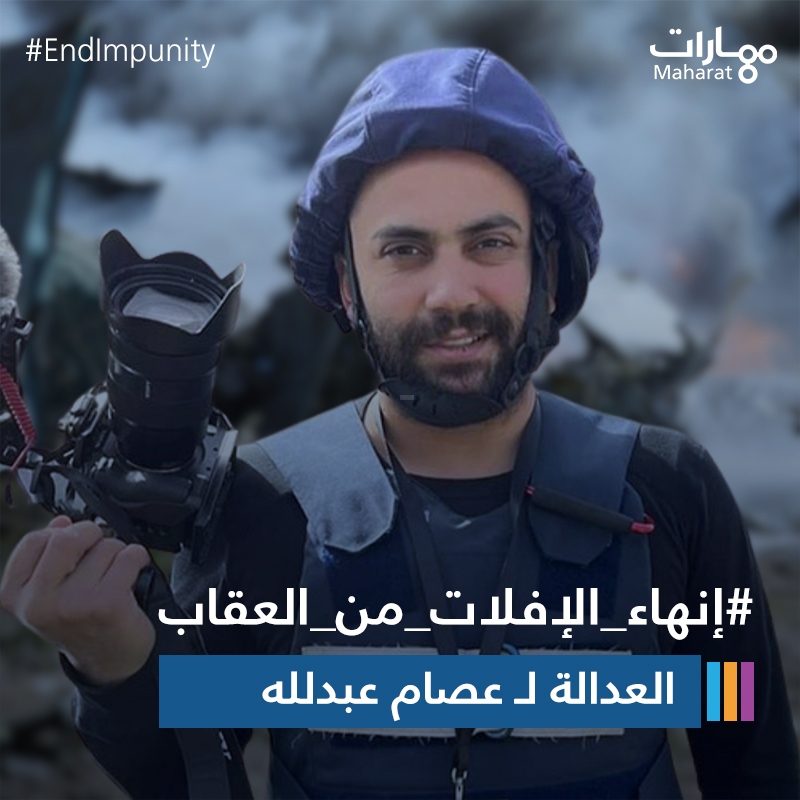
In Lebanon, contrary to what is stipulated in international conventions, resolutions, and action plans, direct threats against journalists and media institutions continue. Since 8 October, Israel has targeted—according to continuously updated figures published by the Samir Kassir Foundation—35 members of media crews, including 18 journalists and 17 cameramen.
These incidents comprise 11 killings and 24 cases of physical assault or injury, in addition to the targeting of certain media outlets such as Al-Manar TV and Al-Nour Radio. Despite this, impunity has prevailed, with no accountability for those responsible for these attacks.
This issue raises several fundamental questions regarding the role of international agreements and resolutions in protecting journalists during wars and armed conflicts, as well as whether the political orientation of journalists and media institutions could ever justify their targeting by Israel. In this context, Lebanese lawyer and researcher Nizar Saghieh explained in a video produced by Maharat Foundation that journalists are fully protected as civilians, and that the political stance of media institutions or journalists can never justify targeting them, which constitutes a war crime.
Dismissal of a journalist after Israeli incitement campaign
Despite the clarity of international agreements, particularly the Geneva Conventions, which recognize journalists as civilians entitled to protection, Israeli threats against journalists have taken multiple forms. In addition to direct attacks, independent journalist Mohamad Zanaty was subjected to an incitement campaign accusing him of supporting terrorism through his field coverage in southern Lebanon. This led to his dismissal from the Associated Press and resulted in increased risks to his personal safety, including the threat of direct targeting, according to Zanaty’s testimony.
Threats to the southern suburbs and a disrupted press tour
The safety of journalists from local, Arab, and international teams was exposed to both psychological and potentially physical threats. On 5 February 2026, the Israeli army spokesperson Avichay Adraee issued a warning targeting the entire southern suburbs of Beirut, coinciding with a media tour organized by Hezbollah for journalists to document the damage. Only half an hour separated the journalists’ arrival from the Israeli warning, which caused panic due to the call for the complete evacuation of the area, marking an unprecedented type of threat.
Cameras captured the state of fear as journalists and photographers were leaving the area. Independent journalist Marwa Saab stated: “We were wearing protective vests and helmets, and as soon as we arrived at the first point to document the damage, the threat spread, and warning gunfire began to alert civilians. We then started gathering and coordinating among ourselves to leave while documenting what was happening.”
Photojournalist Mohamad Kleit recounted his experience dealing with the threat in the southern suburbs, including the challenge of evacuating a foreign journalist from the danger zone amid bursts of warning gunfire near journalists.
Meanwhile, journalist Nagham Rabih from Al-Modon described her experience during the same media tour, highlighting the challenges of accessing information due to the absence of on-the-ground coverage caused by daily shelling and the imposed security measures.
Protecting media teams: a fundamental responsibility of media institutions
Amid the direct and indirect threats faced by journalists and media crews in Lebanon since the beginning of the Israeli war until today, and despite Israel’s disregard for international conventions and resolutions prohibiting the targeting of journalists, the protection of journalists at all levels remains essential and urgent. Media institutions, in particular, have a duty to ensure the highest safety standards for their teams and to prioritize their protection over any journalistic scoop.
In this context, Jad Shahrour, spokesperson for the Samir Kassir Foundation, explained the role of media institutions in safeguarding their teams, including ensuring physical and psychological safety and closely supporting field teams at all levels to guarantee maximum protection.
On 4 February 2026, Legal Agenda published a guide on the protection of journalists during armed conflicts and wars. In addition to outlining state responsibilities, the guide provides a set of professional and practical recommendations for journalists themselves to enhance their safety while covering armed conflicts and to reduce the risks they may face.
Key recommendations include:
- Prior preparation for coverage and understanding the nature of risks in conflict areas.
- Adherence to professional safety procedures and preventive measures during fieldwork.
- Coordination with media institutions on emergency and evacuation plans when necessary.
- Avoiding presence in direct combat zones as much as possible.
- Using appropriate protective equipment during field coverage.
- Working within journalistic teams and maintaining constant coordination with the newsroom.
- Preserving professional neutrality and avoiding involvement in any activity that may compromise the journalist’s civilian status.
- Documenting violations against journalists and reporting them to the relevant authorities.
Domestic threats: between ensuring accountability and avoiding incitement
In addition to Israeli threats, journalists in Lebanon face harassment from domestic actors who prevent them from covering events and accessing information. These practices threaten media freedom and place journalists in a difficult and sensitive position between their professional duty and their personal safety.
In this context, Maharat Foundation team has documented several cases of domestic threats faced by journalists due to their political views or the editorial policies of the media outlets they work for.
On 4 March 2026, MTV journalist Alain Dargham and cameraman Fadi Skaff were subjected to insults and threats in Rachkida in Batroun while covering displacement movements from high-risk areas. The incident was reportedly linked to disagreement with the political stance of the channel they work for, particularly its opposition to Hezbollah and its involvement in the ongoing conflict between Iran and Israel.
Although such domestic incidents have remained relatively limited since the resurgence of war on 2 March 2026, they nonetheless hinder journalists’ work. In this context, lawyer and researcher Nizar Saghieh explains that domestic threats constitute a crime and pose a serious threat to freedom of opinion and expression, and must therefore be prosecuted. He also stresses the responsibility of media outlets to avoid inflammatory rhetoric that could provoke public hostility against journalists.
As an example of how the politicization of humanitarian issues in media coverage can fuel emotions and lead to attacks against media crews, the former dean of the Faculty of Information at the Lebanese University, Dr. George Sadaka, explains: “One of the main observations when watching coverage of displacement issues is the attempt to politicize reporting. Most media institutions present narratives of displacement in line with their political orientation. Some highlight the views of displaced people criticizing Hezbollah and holding it responsible for the war, while others present the views of displaced individuals who affirm their continued commitment to the resistance regardless of the cost.”
Action against domestic perpetrators has begun
At the official level, authorities have announced the start of action. Minister of Justice Adel Nassar stated that the ministry had been informed that “armed individuals, believed to be affiliated with Hezbollah, had obstructed journalists near the Kafaat area. Consequently, I immediately contacted the Public Prosecutor at the Court of Cassation, Judge Jamal Al-Hajjar, and the Government Commissioner at the Military Court, Judge Claude Ghanem, who are directly following up on this matter. They have in turn contacted the security services to pursue the case and take all necessary legal measures.”
In light of all these testimonies from field journalists and media freedom experts, and with the continued emergence of controversial and divisive media issues, such as the recent MTV report alleging the existence of Hezbollah-run prisons in the southern suburbs and identifying their locations on a map, the fundamental objective of all laws, frameworks, and media practices remains the protection of the right to practice journalism without physical attacks or threats. This includes ensuring the safety and freedom of media teams, as well as their consistent adherence to core professional and ethical standards when covering news and issues, away from incitement and hate speech.
The international dimension
The international dimension serves as a key reference for understanding mechanisms for protecting journalists during conflicts. European countries and international institutions have developed standards and practices aimed at reducing the risks faced by media professionals in the field. In light of the challenges faced by journalists in Lebanon, it is essential to compare the local reality with these standards in order to identify gaps and explore how international experiences can be leveraged to enhance the protection of journalists from threats during wars and armed conflicts.
As noted earlier, the Geneva Conventions and Additional Protocol I form the cornerstone of journalist protection in armed conflicts. This is complemented by a series of United Nations Security Council and Human Rights Council resolutions, the UN Plan of Action on the Safety of Journalists and the Issue of Impunity, and related reports, all of which stress the necessity of protecting journalists and holding perpetrators accountable to ensure media freedom and prevent impunity.
In this context, particularly at the European level, Marius Dragomir, Director of the Media and Journalism Research Center (MJRC), explained in a recorded video the international agreements on which European countries rely to protect press freedom. He also pointed to the development by the Council of Europe and the European Union of policies and mechanisms aimed at enhancing the safety of journalists and improving responses to the threats they face.
Thus, in light of escalating conflicts and increasing risks, the protection of journalists in Lebanon lies at the intersection of clear international legal frameworks and a fragile field reality that lacks minimum safeguards. Between threats of military targeting, domestic attacks, and weak institutional protection measures, journalists remain the most vulnerable actors, despite being entitled to full protection. While international standards offer models that can be drawn upon, responsibility remains shared between the state and media institutions to ensure a safer environment that guarantees journalists’ right to report information without endangering their personal safety.
This report was prepared as part of the project “Support to Media Reform in Lebanon to Enhance Freedom of Expression,” with the support of the European Union.