27 April 2026
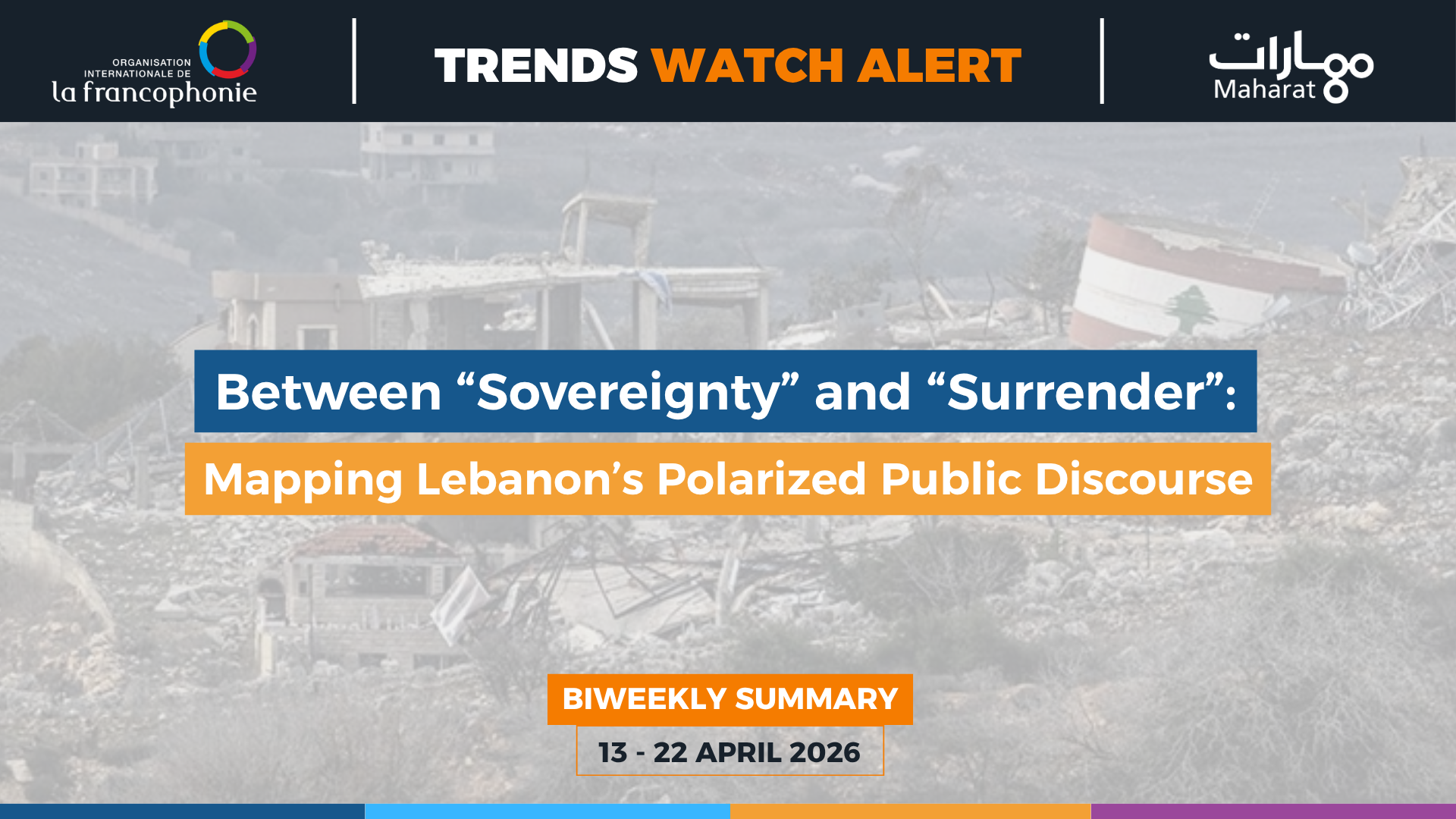
Trends Watch Alert | Biweekly Summary 13 - 22 April 2026
The ongoing war in Lebanon and the broader Middle East has caused a deep divide within Lebanese society regarding this war, its causes, and the responsibility of the parties involved. This internal division is not limited to this issue; it has extended to many domestic topics and positions, so that numerous Lebanese affairs and various political, social, and other stances have become axes of alignment, disputes, and conflicting narratives. Added to this are numerous violent and inflammatory speeches, as well as distorted or false news, which exacerbate internal divisions.
Therefore, this project monitors social and political discourse in the public sphere by following issues that media outlets, social media platforms, and influencers prioritize, with the aim of shedding light on them, tracking their narratives, understanding who stands behind them, and assessing the risks they carry. These topics often reflect societal trends and reveal the positions of key actors regarding them.
Between 13 and 22 April 2026, a series of major political developments triggered intense public debate in Lebanon. This period followed “Black Wednesday” on 8 April, when Israeli strikes targeted Beirut and several regions, resulting in more than 300 deaths and around 1,000 injuries.
Politically, two key developments shaped the debate: the Cabinet’s decision on 9 April to declare Beirut a “weapons-free city”, and the government’s position on negotiations, including its refusal to allow Iran to represent Lebanon in talks with the United States and its affirmation of Lebanon’s sovereign right to engage in direct negotiations with Israel under American mediation.
The report identifies two polarizing narratives: a “sovereignty” narrative supporting these decisions, and a “surrender” narrative opposing them. Both were amplified by political actors, media outlets, and social media users, reinforcing perceptions of deep societal division. The analysis also examines how these narratives were constructed, framed, and their broader national implications.
Read the report in English: Between "Sovereignty" and "Surrender": Mapping Lebanon’s Polarized Public Discourse
Read the report in French: Entre "souveraineté" et "capitulation": cartographie d’un débat public polarisé au Liban
This series of reports is prepared with the support of the Organisation internationale of la Francophonie (OIF).