30 April 2026
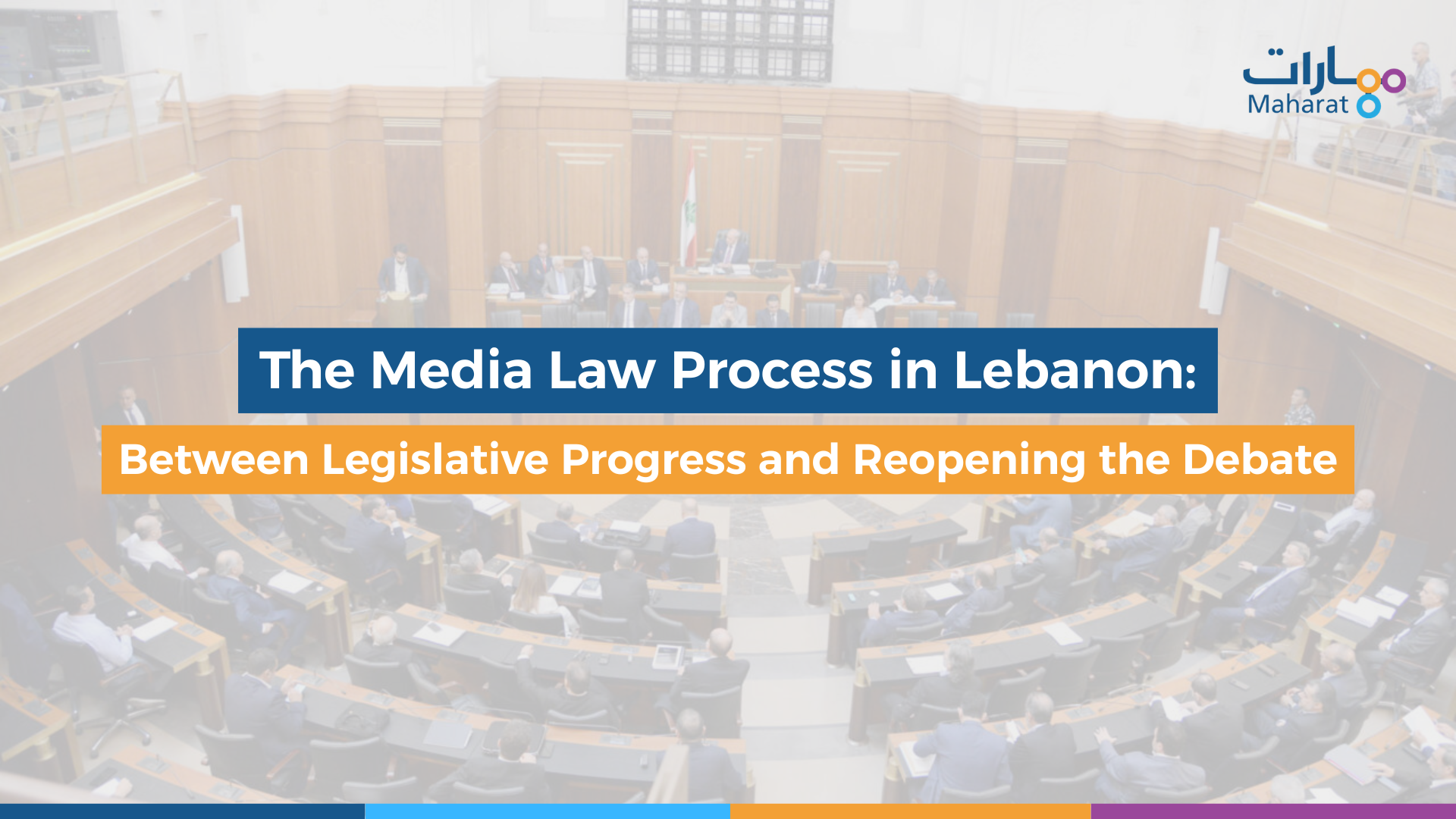
The Media Law Process in Lebanon: Between Legislative Progress and Reopening the Debate
A few days after the announcement of the ceasefire, at a moment that was expected to bring de-escalation and renewed focus on reform priorities, the draft media law saw a notable development on April 21. The text finalized by the Administration and Justice Parliamentary Committee was referred to the joint parliamentary committees, in parallel with the submission of a separate draft law by MP Ghazi Zaiter just days before the session. This development has raised questions about the trajectory of the law’s adoption, particularly after years of discussions that had produced an advanced draft previously referred to the Parliament’s General Assembly.
During the joint committee's session held on April 23, two main approaches emerged. The first called for proceeding with the draft that had been developed over years of deliberation, while the second favored allowing more time to revisit certain provisions. At the conclusion of the session, it was agreed to form a subcommittee chaired by MP Elias Bou Saab, tasked with addressing points of contention and was given a 15-day deadline to submit its report.
Amid Lebanon’s multiple overlapping crises, particularly during the war period and the accompanying rise in risks faced by journalists, alongside the spread of hate speech and disinformation, the need for adopting a modern media law has become increasingly urgent. Such a law is essential to keep pace with rapid transformations, ensure effective protection of freedom of expression, and regulate media responsibility.
In this context, the draft media law developed by the Administration and Justice Committee, following years of deliberations and the work of successive committees, most recently the subcommittee chaired by MP Georges Okais, represents an advanced attempt to modernize the legal framework in line with international standards. It aims to strengthen principles of governance, independence, and protection within the media sector, making it one of the most prominent reform initiatives currently on the table.
The Freedoms Coalition in Lebanon Calls on MPs to Reject Obstruction
In detail, a session of the joint parliamentary committees was held on April 23, 2026, with several draft laws on its agenda, most notably the general amnesty proposal and the media law proposal submitted by MP Ghazi Zaiter just a few days prior to the session. This development complicated the legislative path of the final version of the media law draft that had been prepared by the Administration and Justice Committee.
One day before the session, the Freedoms Coalition in Lebanon issued a statement noting that “including the draft law as finalized by the Administration and Justice Committee on the agenda of the joint committees, in parallel with the submission of MP Zaiter’s proposal, constitutes a deliberate attempt to undermine the extensive efforts invested over years to develop a new media law, at a time when there is an urgent need for legislation that protects journalists, counters hate speech, and regulates the social responsibility of the media.”
The coalition also addressed members of parliament, urging them to reject any new obstruction to this process and to insist on adopting the latest version approved by the Administration and Justice Committee, as a step toward discussing it in the Parliament’s General Assembly.
Zaiter’s Proposal: An Old-New Law and Journalists’ Concerns Over Derailing Reform
Regarding the draft law submitted by MP Ghazi Zaiter, the Freedoms Coalition in Lebanon explained that he registered the media law proposal on April 14, 2026, under number 308, and that it was referred to the joint committees on April 15, 2026. It also became clear that the content of this proposal is identical to the one previously submitted by former MP Ghassan Moukheiber in 2010, in collaboration with Maharat Foundation, under number 44/2010.
Elsy Moufarrej, president of the Union of Journalists in Lebanon, expressed regret that the draft law was sent back to the joint committees instead of being referred to the Parliament’s General Assembly for a vote. She considered that what is happening “suggests that the objective is to derail the reforms or to block the law altogether.”
Moufarrej noted that the draft law initially submitted by former MP Ghassan Moukheiber and Maharat Foundation 16 years ago had undergone a long trajectory, ranging from attempts to distort its content and spirit and shelving it, to more recent developments over the past three years, during which the proposal was revisited through a reform process within the subcommittee chaired by MP Georges Okais. This process involved members of Parliament, civil society actors, and professional syndicates, including the union as a partner in these reform efforts.
She also addressed MPs, urging them not to waste years of work and to move forward with adopting a law that abolishes criminalization and prison sentences while ensuring the protection of journalists.
From its side, Maharat Foundation has consistently advocated for a set of core reforms, which it considers reflected in the latest version approved by the Administration and Justice Committee, in preparation for discussion in the Parliament’s General Assembly. These include protecting freedom of expression rather than criminalizing it; limiting legal accountability to civil frameworks, thereby abolishing prison sentences and criminal prosecutions in favor of civil liability; setting precise boundaries for hate speech without undermining public debate; and ensuring a safe environment for journalistic work, including the protection of source confidentiality. The establishment of an independent and transparent regulatory body is also no longer optional, but a necessity to restore trust in media sector governance and to regulate the social responsibility of the media.
Advancing these reforms today constitutes a serious test of Parliament’s willingness to protect rights and freedoms, and to move from crisis management toward building a modern legal framework that responds to current challenges. The committee that has been formed is therefore expected to expedite the referral of the draft law to the General Assembly, incorporating these essential reforms.
Parliamentary Positions: Diverging Approaches to the Legislative Process
Before the Session Began
In parallel with the discussions preceding the joint committee's session, several parliamentary positions emerged, reflecting differing assessments of the legislative path being followed.
Just minutes before the session began, MP Razi El Hage stated in an interview with Maharat Foundation that “parliamentary work follows a clear legislative process, and the draft law submitted by one of our colleagues was not a sound decision, especially given the existence of a ready media law proposal that had already been discussed and approved within the Administration and Justice Committee, of which he is a member.” El Hage described what had happened as “a clear obstruction to the process of adopting the media law.”
In a similar vein, MP Fadi Karam expressed regret over MP Ghazi Zaiter submitting a draft law at the last minute after a long process of discussions and consensus-building over months and years. He considered that this action reflects “a lack of understanding of the legislative process,” adding that what occurred amounts to an attempt to undermine the draft law that had already been discussed and was expected to proceed to the General Assembly for adoption.
On the other hand, MP Hussein Hajj Hassan noted that “discussions had taken place within both the Media and Telecommunications Committee and the Administration and Justice Committee, where different formulations were proposed, necessitating further deliberation to reach a final version.” He considered that “MP Ghazi Zaiter has the right to submit a draft law and have it incorporated,” while also emphasizing “the need to expedite the adoption of a new media law.”
During the Session: Parliament heading towards Paths
During the session, deliberations within the committees reflected this divergence in approaches. In this context, MP Abdul Rahman Bizri explained in an interview with Maharat Foundation that “there is a version that was completed several years ago and requires updating, and another version submitted by the Administration and Justice Committee that has taken certain laws into account.” He added: “We are now facing two options, either to vote on the draft law currently before us, or to form a subcommittee with a 15-day mandate to merge all these proposals into a single draft.”
Bizri further noted that “the Minister of Information and a number of MPs prefer to finalize what is currently on the table, out of concern that the adoption of a modern media law could be delayed,” pointing to the ongoing debate between accelerating adoption and allowing more time to revisit certain provisions.
The Formation of the Subcommittee: A Point of Contention or a Pretext for Derailment?
Following the conclusion of the joint committees session, divergent positions emerged, reflecting the continued debate over the trajectory of the media law, particularly in light of the decision to form a subcommittee to revisit certain points.
In this context, Minister of Information Paul Morcos clarified that the draft prepared by the Administration and Justice Committee “aims to protect freedom of opinion and expression by clearly defining who qualifies as a journalist, abolishing prison sentences and replacing them with fines, and adopting fast and effective mechanisms to address media violations.”
He also noted that the draft “provides for the establishment of an independent media authority, the reorganization of public media within a unified platform, and, for the first time, offers a detailed treatment of hate speech and mechanisms to combat it. It also regulates online media outlets to curb misinformation, while preserving the role of platforms that adhere to professional standards.”
Morcos added: “We were surprised today, within the joint committees, that this text was pushed backward through the formation of a subcommittee chaired by the Deputy Speaker of Parliament to review remaining comments, comments that could have been addressed within the committees earlier.”
On the other hand, Deputy Speaker of Parliament and head of the newly formed subcommittee, Elias Bou Saab, considered that reopening the discussion falls within the normal course of legislative work. He noted that “despite the issuance of a report by the Administration and Justice Committee and the holding of numerous sessions with experts, this does not negate the need for amendments, nor does it undermine the legitimacy of MPs to submit draft laws and propose changes.” He added that he believes Minister of Information Paul Morcos also agrees that some amendments are necessary.
When asked about the points of contention, Bou Saab clarified that he “has not yet begun discussing the media law,” noting that the newly formed subcommittee will set a schedule for its meetings to examine the file. He added that circulating information suggests the disagreement may focus on the issue of the formation of the National Media Council to which Morcos commented: “Hopefully, that will be the extent of it.”
The Need to Accelerate Procedures and Move to the General Assembly
For his part, MP Georges Okais expressed dissatisfaction with the direction the discussions have taken, stating that “the only effective resistance today is resistance to reform.” He pointed out that after “11 sessions within the Administration and Justice Committee and 16 sessions in the subcommittee, we were expecting direct referral to the General Assembly. However, we were surprised at the last minute, just days before the joint committees convened, by the introduction of a draft law submitted by one of our colleagues in an unusual move.”
At the same time, Okais stressed the importance of the next phase, expressing hope that “the subcommittee will complete its work as quickly as possible and that procedures will be accelerated so that the media law can move forward to where it should be.”
This report was prepared as part of the project “Support to Media Reform in Lebanon to Enhance Freedom of Expression,” with the support of the European Union.