05 November 2026
Youth Forum 2026
In Baalbek, when the team behind the “It’s Not a Secret” campaign asked citizens and public officials about the right to access information, they found that awareness of this right was limited, even among some public administration employees. This observation evolved into an awareness-raising campaign and training sessions, followed by a practical step: submitting information requests to municipalities in the region. Over three weeks, the campaign’s content generated around 70,000 views, while some participants learned for the first time about their right to request information and use it to hold public institutions accountable.
This was one of five youth-led initiatives presented during the Youth Forum on Information Integrity and Democratic Participation, organised by Maharat Foundation on 24 October 2026 in Beirut. The forum brought together youth groups from Beirut and Mount Lebanon, Baalbek, Akkar, Saida and Tripoli, who had developed media campaigns addressing challenges affecting their communities: from the lack of information on public spending to WhatsApp rumours, electoral disinformation and hate speech against women.
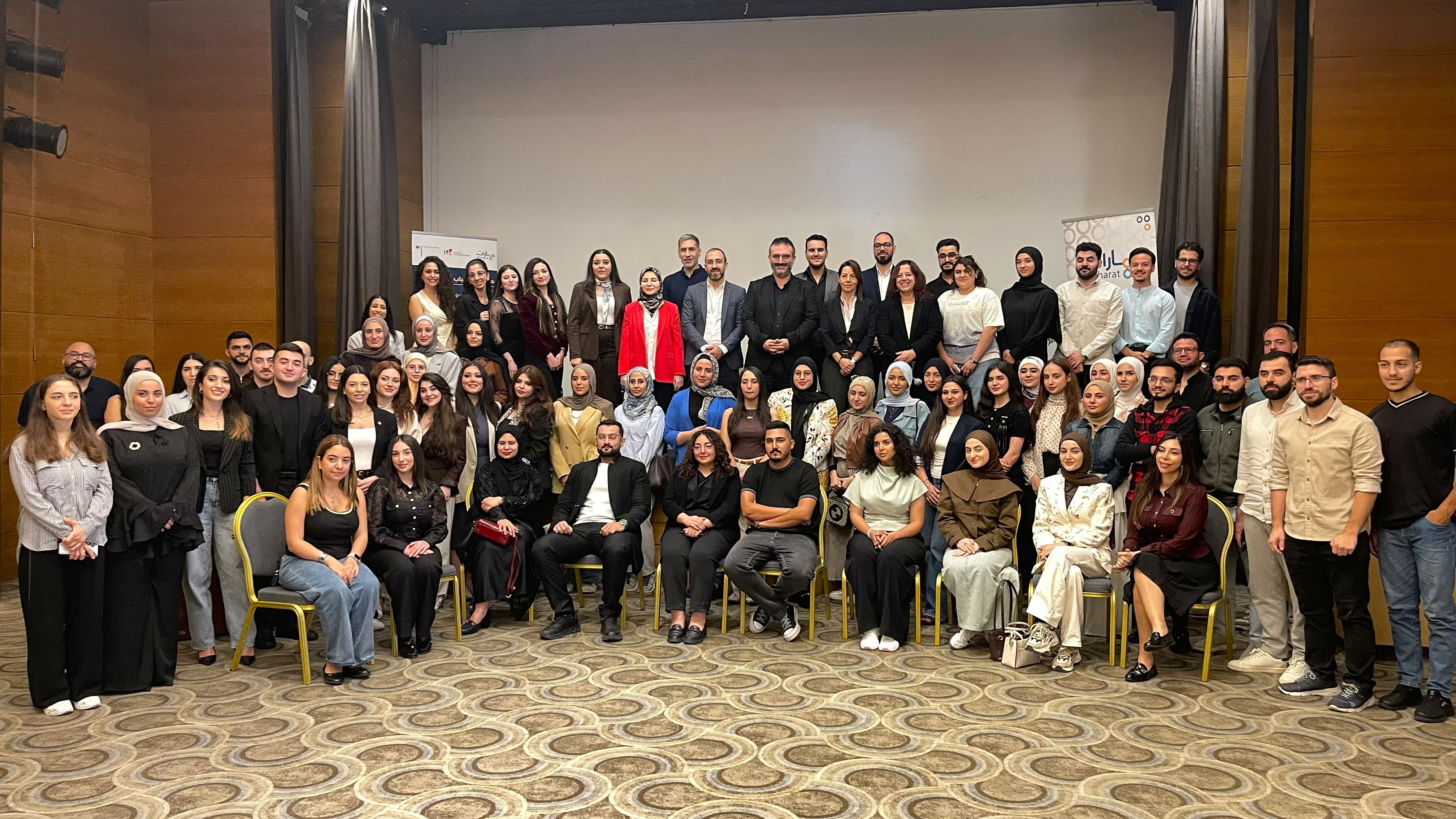
The forum brought together around 50 young women and men, alongside representatives of public institutions, universities, the media and civil society, as part of Global Media and Information Literacy Week. All participants jointly developed a shared commitment to information integrity and democratic participation. Its key commitments included:
Verifying information before sharing it, and limiting the spread of disinformation and rumours.
Rejecting hate speech and discrimination, and protecting public debate and freedom of expression.
Demanding our right to information, and making use of transparency and accountability tools.
Using artificial intelligence responsibly, and rejecting disinformation, manipulation, abuse and violations of privacy.
Turning knowledge into initiatives, and continuing to collaborate to strengthen information integrity in our local communities.
The commitment also called on relevant institutions to create opportunities for collaboration, build on youth-led experiences, and facilitate the exchange of expertise, tools and resources, in order to translate the forum’s recommendations into practical initiatives that strengthen the right to information, trust, accountability and democratic participation in Lebanon.
The forum marked the culmination of the project “Empowering Youth for Information Integrity and Democratic Participation in Lebanon”, supported with German Federal Foreign Office’s funds by ifa (Institut für Auslandsbeziehungen), zivik Funding Programme.

Watch the report on the forum
Five Campaigns Starting with People's Questions
-
Alongside the “It’s Not a Secret” initiative, presented by Maryam Abou Khoder, Dayan Bou Karroum presented the Beirut and Mount Lebanon group’s “Keep an Eye on Public Procurement” campaign. The campaign stemmed from young journalists’ and journalism students’ limited understanding of public spending and procurement mechanisms. The experience helped participants understand the law and how information requests can be used to monitor municipalities’ work and hold them accountable.
-
In Akkar, the “Akkar Verifies” campaign addressed the rapid spread of inaccurate news through social media and WhatsApp groups. Abdel Rahman Khaled explained that, in collaboration with the Spotcast platform, the team worked to promote verification before believing or sharing information. One of the key lessons was that using examples drawn from people’s everyday lives and correcting misinformation respectfully helps foster dialogue and build trust.
-
In Saida, the “Expose It” campaign focused on tackling propaganda and political disinformation during elections. Jana Al-Hanafi presented the team’s experience, developed in collaboration with Sama Saida, based on the conviction that raising awareness remains essential even if elections are postponed.
-
From Tripoli, Zeina Hammoud presented the “Why Her?” campaign, which addressed hate speech against women in the age of artificial intelligence. The team developed content to explain key concepts in accessible terms and encourage people to think before publishing. This content was brought together in a dedicated space on the Ana Al-Mohtawa platform.
These experiences demonstrated how young people moved from learning to training, content production, and engagement with public administrations and local communities. They also highlighted their need for accessible information, partnerships, and support to ensure the continuity of their initiatives.
What Do These Initiatives Need to Continue?
Building on the presentations, the panel discussion “How Can We Protect Information Integrity in Times of Crisis?” explored the responsibilities of different stakeholders in addressing disinformation and strengthening democratic participation.
The Director General of Political Affairs and Refugees at the Ministry of Interior and Municipalities, Faten Younes, emphasised the role of the media in connecting the public with candidates and the electoral administration, as well as the importance of making official information accessible and verifying information before resharing it. She warned against the use of AI-generated images and voices to target women candidates, and called for stronger political education and greater youth participation.
Rami Jabbour, Peacebuilding Project Manager at the United Nations Development Programme (UNDP), linked efforts to counter disinformation with social cohesion, highlighting the role of local pages and initiatives that are close to their communities, as well as the need to exchange tools and expertise and promote continuous learning.
From an academic perspective, Dr Edmond Bou Dagher, Head of the Department of Journalism and Communication at the Holy Spirit University of Kaslik (USEK), stressed the importance of connecting education with professional practice and facilitating access to information, noting that withholding information creates an information vacuum that can be filled with misleading content. Dr Sima Hamadeh, from Haigazian University, called for integrating media and information literacy into school curricula and across academic disciplines, highlighting the impact of health disinformation on everyday life.
Roula Mikhael, Executive Director of Maharat Foundation, emphasised that individual responsibility for verifying information requires a supportive environment that ensures access to information and training. She also stressed the importance of documenting experiences and translating their lessons into recommendations and policies that strengthen transparency and accountability.

Four Working Groups to Turn Discussion into Action
Following the panel discussion, participants split into four working groups to identify key challenges and the stakeholders responsible for addressing them. Each group then presented its findings to the forum:
Combating Hate Speech
The group recommended establishing clear standards that protect freedom of expression, training journalists in gender-sensitive reporting, supporting women journalists in addressing threats, improving reporting mechanisms, and supporting youth-led initiatives.
Access to Information and Accountability
The group called for the enforcement of the law, proactive disclosure of information and responses to information requests within the legally stipulated deadlines. It also recommended appointing information officers, digitising documents, and facilitating the submission and follow-up of information requests.
Verification During Crises and Elections
The group emphasised the importance of taking time to verify information before publishing, providing practical training, and establishing cooperation networks among journalists, fact-checkers, universities and local initiatives. It also called for engaging municipalities in disseminating reliable information.
Artificial Intelligence
The group recommended adopting clear newsroom policies that ensure human oversight, transparency and data protection. It also called for strengthening verification skills, improving responses to blackmail, harassment and misleading synthetic content, while safeguarding rights and freedom of expression.