12 May 2026
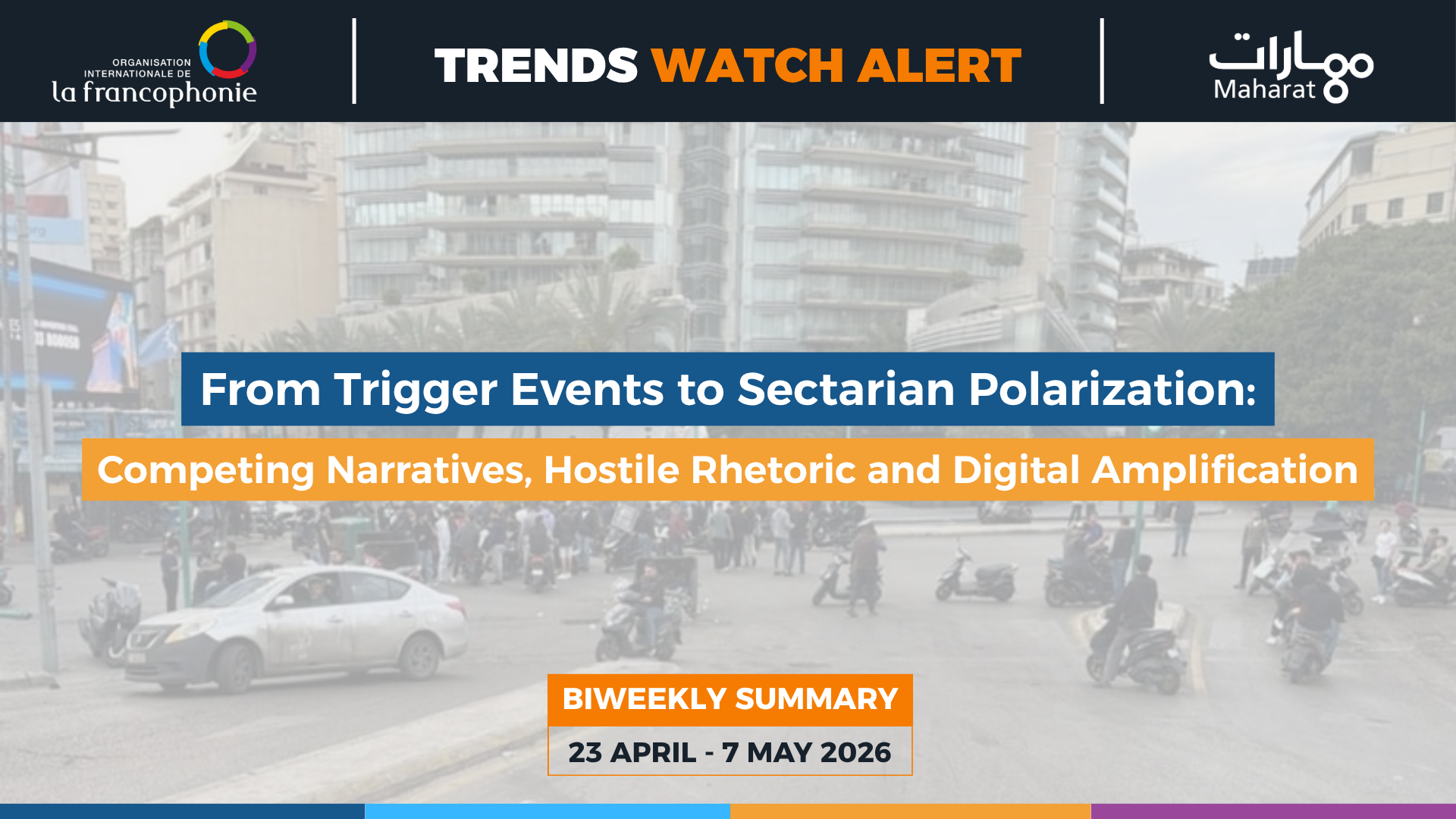
Trends Watch Alert | Biweekly Summary 23 April - 7 May 2026
The ongoing war in Lebanon and the broader Middle East has caused a deep divide within Lebanese society regarding this war, its causes, and the responsibility of the parties involved. This internal division is not limited to this issue; it has extended to many domestic topics and positions, so that numerous Lebanese affairs and various political, social, and other stances have become axes of alignment, disputes, and conflicting narratives. Added to this are numerous violent and inflammatory speeches, as well as distorted or false news, which exacerbate internal divisions.
Therefore, this project monitors social and political discourse in the public sphere by following issues that media outlets, social media platforms, and influencers prioritize, with the aim of shedding light on them, tracking their narratives, understanding who stands behind them, and assessing the risks they carry. These topics often reflect societal trends and reveal the positions of key actors regarding them.
In this report, the second in a series titled Trend Watch Alert, covering the period from 23 April to 7 May 2026, two case studies, the Saqiyat al-Janzir security operation in Beirut and an AI-generated satirical video broadcast by LBCI, illustrate how relatively contained trigger events can rapidly evolve into nationwide debates marked by competing narratives, hostile rhetoric, and digital escalation.
It highlights how framing practices by various actors, centered on provocation, identity-based interpretations, and broader crisis narratives, together with online amplification mechanisms, contribute to shifting public discourse from specific incidents toward wider polarization.
Read the report in English: From Trigger Events to Sectarian Polarization: Competing Narratives, Hostile Rhetoric and Digital Amplification
Read the report in French: De l’événement déclencheur à la polarisation: entre récits concurrents, rhétorique hostile et amplification numérique
This series of reports is prepared with the support of the Organisation internationale of la Francophonie (OIF).