07 September 2026
The 2026 War in the Public Sphere: Media Narratives Around National Issues
Since October 2023, Lebanon has lived through a war that began along the southern border and gradually expanded to affect different parts of the country, including the capital, Beirut. As the war expanded, its repercussions were not limited to the military sphere but also extended into Lebanon’s domestic sphere, reopening political and social divisions over the war, Lebanon’s position toward it, and the concepts of the state, the homeland, and resistance.
In this context, Lebanon’s public sphere became filled with statements, reactions, and competing narratives. Newspapers, social media platforms, influencers, and opinion leaders did not merely report what was happening; they also contributed to shaping different portrayals of the war, its parties, and Lebanese society itself.
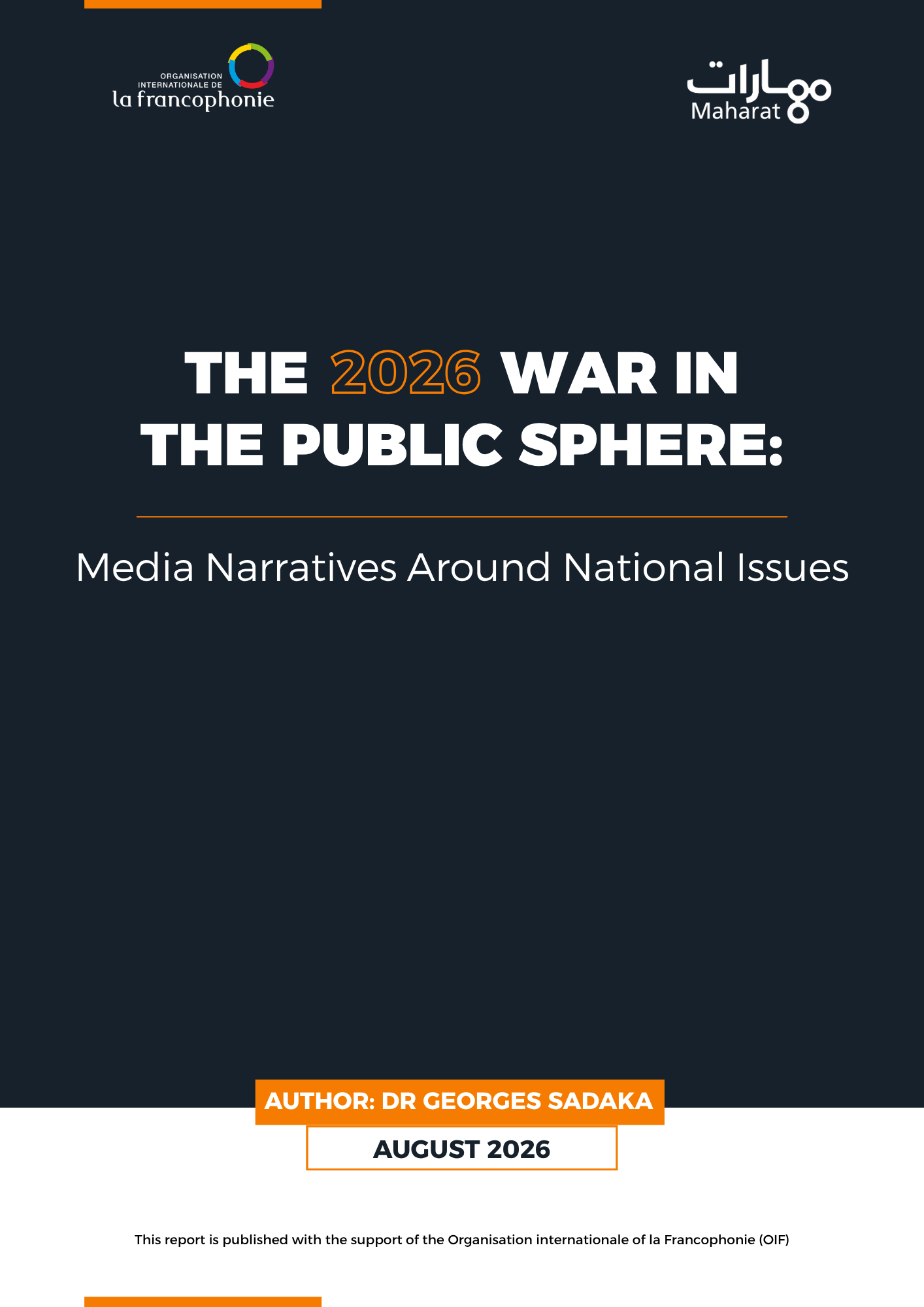
Against this backdrop, Maharat Foundation launched its new report, “The 2026 War in the Public Sphere: Media Narratives Around National Issues” prepared with the support of the Organisation internationale de la Francophonie. The report analyses social and political discourse in Lebanon’s public sphere over three months of monitoring, from April to June 2026, a period that witnessed a major escalation in the war.
The report set out to answer a number of key questions: What did newspapers document about the war? Which issues received the most coverage? What did influencers and content creators discuss? How was the war narrated? Where did the citizens who experienced fear, displacement, and loss feature in this coverage? And, most importantly, what memory of this war is being constructed for future generations?
The report’s findings showed that media coverage clearly reflected the deep divide within Lebanese society. Two opposing sides and conflicting narratives of events emerged, while space narrowed for positions falling outside this polarisation.
The divide was apparent not only in political positions, but also in the language itself. The report identified discourse that often relied on exclusion, accusations of treason, and questioning of belonging, at times going as far as threats of accountability or violence. The other, who is fundamentally a fellow citizen and member of the same nation, appeared in some narratives as an adversary, and at times as an enemy.
These narratives also reflected a deeper struggle over the concept of the homeland, its identity and future, and over who has the right to define the “correct” narrative about it. Even state institutions, which are supposed to serve as a unifying space, were not spared accusations of treason or subordination.
In this sense, during the 2026 war, Lebanese people did not experience just one war, but two parallel wars: a military war on the ground and a media war over the narrative and its meaning.
While the military war destroyed villages and homes and claimed victims, the war of narratives contributed to deepening divisions and reproducing the language of incitement, fearmongering, and accusations of treason. At times, media discourse was no longer merely a vehicle for reporting facts; it became part of the battle itself.
Facts became intertwined with misleading information, while targeted discourse aimed at ideologically influencing audiences often prevailed. A single event came to be narrated in contradictory ways, depending on who was telling the story and the position they were defending.
The struggle was not limited to interpreting the present; it also extended to memory.
Each narrative worked to construct its own selective memory, choosing events, images, and symbols that aligned with its own vision and objectives, rather than contributing to the construction of a shared national memory. These narratives also offer insight into how audiences were mobilised, how the other was demonised, and how deep disagreements over the homeland, its identity, and its future were reflected in media discourse.
Yet amid this major struggle over the narrative, one fundamental absence stood out: the citizen.
News about politicians, their statements, and their positions dominated a large part of the coverage, while people’s daily stories and suffering often remained on the margins.
Behind every displaced family, every victim, and every home destroyed, there was a story that the media could have documented. Yet the monitoring showed that investigative reporting on social issues and coverage following the daily lives of citizens were very limited in a number of newspapers, with some exceptions that devoted greater space to humanitarian and social issues, including the coverage by L’Orient-Le Jour.
At the same time, another absence emerged: the lack of sustained official communication throughout the war. There was no continuously present official national narrative providing citizens and the media with facts and information, which could have helped reduce the information vacuum and limit the spread of disinformation and inflammatory rhetoric.
In this vacuum, the narratives of the various actors gained ground. Israeli military spokesperson Avichay Adraee, for example, became a source followed by part of the Lebanese public to learn about developments on the ground. Some of the terms and expressions used in his discourse also made their way into parts of the Lebanese media, contributing to strengthening the presence of the Israeli narrative within Lebanon’s media sphere.
Ultimately, the report shows that what remains of a war is not limited to what happened on the ground.
What also remains is what was said about it, how it was narrated, who was present in telling its story, and who was absent.
The press and social media do not merely document events; they also contribute to shaping how society will remember those events in the future.
By analysing the competing narratives during the 2026 war, the report documents how political and social divisions were reflected in the public sphere, and how the conflict over the war became a conflict over narrative, identity, and memory.
Read the full report:
In English: The 2026 War in the Public Sphere: Media Narratives Around National Issues
In French: La guerre de 2026 dans l’espace public: Les récits médiatiques autour des enjeux nationaux
In Arabic: حرب 2026 في الفضاء العام: سرديّات الإعلام حول إشكاليات الوطن